SATURDAY, NOVEMBER 14, 2026  /  WEEKEND EDITION

CASH & CHAOS

MARKETS, MONEY AND THE MADNESS IN BETWEEN.

In partnership with

Nvidia fell nearly 13% in a week when the S&P 500 gained 2.5%. The AI boom is still attracting money. Shareholders are getting more particular about who runs it, who finances it and who gets paid.

Nvidia’s customers still have chips to buy.

New York Stock Exchange exterior

Ken Lund / Wikimedia Commons. NYSE, CC BY-SA 2.0.

Nvidia lost 12.75% this week while AMD gained 18.93% and Broadcom rose 18.16%. Investors sold the company at the center of the AI buildout and bought two of its alternatives. Now the businesses have to justify that split.

Jensen Huang’s departure gives rivals a chance to make their pitch. Nvidia’s installed hardware, software and customer commitments make switching expensive. An investor can buy a different stock in seconds. A cloud company changing the systems on which its customers run AI has considerably more work to do.

StockNov. 6 closeNov. 13 closeWeek
Nvidia$186.64$162.85−12.75%
AMD$449.04$534.06+18.93%
Broadcom$293.69$347.01+18.16%
CoreWeave$46.40$53.13+14.50%
Nebius$129.49$115.88−10.51%

Regular-session closes, November 6 to November 13. Price returns exclude dividends. Data provided by Zacks Investment Research, Inc., www.zacksdata.com.

South Korea offers an early answer about existing commitments. Its science minister said Nvidia reaffirmed its pledge to supply up to 260,000 GPUs. The agreement predates Huang’s resignation and covers future deliveries. The country still needs the equipment it planned to buy when he was in charge.

The harder question concerns the next round of purchases. Developers have built applications around Nvidia’s CUDA software, and customers have designed infrastructure around its chips. Those investments give customers reasons to stay. They also give customers reasons to cultivate another supplier before they become even more dependent on Nvidia.

AMD and Broadcom can benefit from those additional purchases without persuading customers to rip out their Nvidia systems. AMD’s data-center sales reached $8.55 billion last quarter, up 97%, including server processors as well as AI accelerators. Broadcom offers custom chips and networking equipment. Customers have several ways to spread their next dollar of spending around.

Interim CEO Colette Kress must preserve the customer relationships and engineering teams Huang helped build. Wired reported more than 1,600 comments on an internal post, including calls for his return. The Financial Times reported an approach to Arm CEO Rene Haas; Nvidia’s board said it had not formally engaged any candidate. Customers are making commitments that will outlast that search.

Access to China could constrain that successor more directly. Proposed US restrictions include remote access to advanced chips. A customer may prefer Nvidia and still be unable to buy or use its products under tighter rules. That would give alternatives an opening quite apart from the turmoil in the boardroom.

Tuesday’s results cover the period before Huang left: Nvidia guided fiscal Q3 revenue to $108 billion, plus or minus 2%, against a Zacks estimate of about $109.0 billion. The next outlook and customer commentary will say more about whether Nvidia is keeping the next round of orders. This week’s stock-market verdict arrived before that evidence.

South Korea GPU pledge: Reuters report.

More on the proposed chip restrictions: AP’s US-China report.

Earlier coverage: What Huang’s departure meant for Nvidia’s deals.

Read the CEO search update →

Tesla and SpaceX have a price to negotiate.

Tesla Cybertruck

Calreyn88 / Wikimedia Commons. Tesla Cybertruck, 2024.

Elon Musk leads both Tesla and SpaceX. Their shareholders do not necessarily want the same thing from a merger. A generous price for SpaceX would be attractive to its owners and expensive for Tesla’s.

That is the problem behind reports that the two companies are progressing in merger talks. Bloomberg reported the negotiations, and Reuters said an agreement could arrive as early as December. Tesla has disclosed a committee of disinterested directors exploring a closer relationship, including a possible business combination. Neither company has announced a deal.

SpaceX is publicly traded, with businesses ranging from rockets to Starlink. The investment case depends on what Tesla pays and what ownership would accomplish that a commercial agreement could not.

If Tesla pays with new shares, its existing owners would hold a smaller percentage of the combined business. That can be a good bargain when the assets received justify the dilution. It can also transfer value to the sellers if the buyer pays too much. No exchange ratio has been announced.

The committee therefore has a job that a shared founder cannot settle for it: establish terms that make sense for Tesla’s shareholders. An appealing combination of businesses and an appealing purchase price are two separate judgments.

Read Reuters on the talks →

Nebius has customer cash. It needs capacity.

Nebius data center in Finland

Nebius data center, Finland; company archive.

Nebius reported Q3 revenue of $980.8 million versus a $916.8 million pre-results Zacks estimate, and a GAAP diluted loss of $0.13 per share. It expects 2026 revenue at the low end of its $3.0 billion–$3.4 billion range.

MetricReported / outlookPrior estimate
Q3 revenue$980.8M$916.8M
GAAP diluted EPS−$0.13–
2026 revenueLow end of $3.0B–$3.4B–

Data provided by Zacks Investment Research, Inc., www.zacksdata.com. Estimates are historical pre-results estimates; GAAP and adjusted EPS are not directly comparable.

Getting paid before delivering the service is useful when you are building data centers. Customer prepayments helped Nebius generate $4.23 billion of operating cash inflow in the first nine months. The company gets construction funding; customers get a claim on future computing capacity.

That arrangement makes delivery dates important. Delays involving third-party facilities pushed Nebius’s goal of an annualized revenue run rate above $7 billion to February, after it had targeted $7 billion to $9 billion in December. Run rate takes one month’s revenue pace and annualizes it. A later start delays the months in which that capacity can earn revenue.

Spending is moving in the opposite direction. Nebius spent $7.3 billion on property, equipment and intangible assets in Q3 and used $273 million in operating cash during the quarter. It raised its 2026 capital-spending forecast to about $27 billion from $20 billion to $25 billion.

For 2027, management projects $12 billion to $13 billion of revenue and $40 billion to $45 billion of capital spending. It expects prepayments and asset-backed financing to cover 75% to 85% of that spending and targets pretax breakeven in the fourth quarter. That profitability target does not mean the construction program will fund itself.

Customers willing to pay ahead are a substantial advantage. But cash collected early does not remove the obligation to deliver, and borrowing against equipment still creates a financing cost. Nebius’s shareholders are funding the gap between a much larger business under construction and the smaller one earning revenue today. The stock finished the week down 10.51% at $115.88.

Earlier coverage: Our original Nebius earnings coverage.

Read Nebius’s shareholder letter →

CoreWeave’s interest expense dwarfs its operating profit.

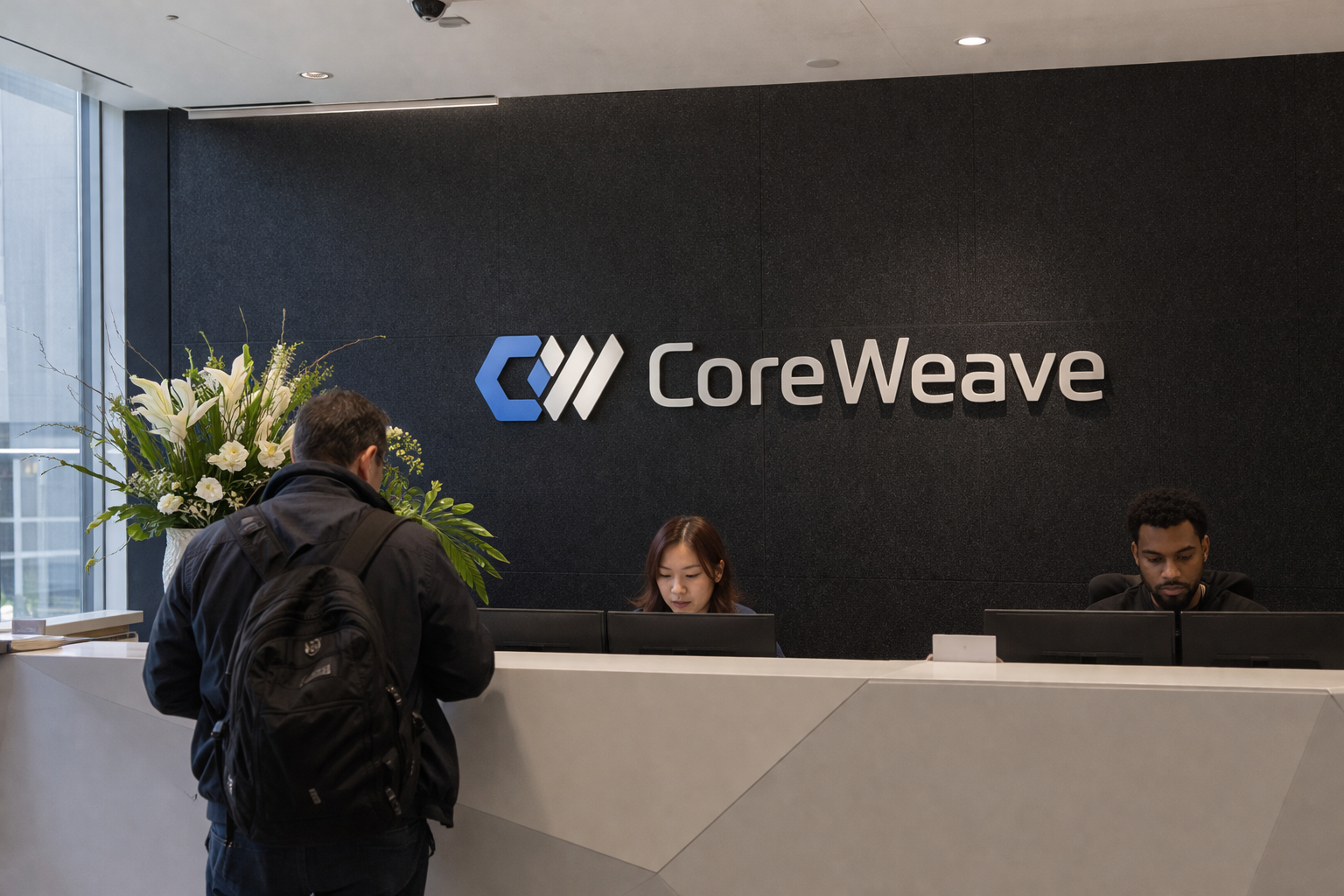
CoreWeave office and logo

CoreWeave office and logo; archive via Invezz.

CoreWeave reported Q3 revenue of $3.66 billion versus the $3.54 billion pre-results Zacks estimate. Its adjusted loss was about $0.95 per share versus an estimated $1.16 loss. It raised its 2026 revenue forecast to $13.0 billion–$13.3 billion.

MetricQ3 result / guidePrior estimate
Revenue$3.66B$3.54B
Adjusted EPS−$0.95−$1.16
2026 revenue guide$13.0B–$13.3B–

Adjusted EPS calculated from company-reported adjusted net loss and diluted shares. Data provided by Zacks Investment Research, Inc., www.zacksdata.com.

CoreWeave’s cloud business produced $207 million in operating income last quarter. Net interest expense was $846 million, more than four times as much. Financing and other items turned the operating profit into a $709 million net loss.

The company has no shortage of contracted business to build toward. Backlog reached $132.5 billion at September 30, up from roughly $104 billion three months earlier. The difficulty is that delivering those contracts requires equipment, buildings and power before the associated revenue can be recognized.

CoreWeave forecasts $37 billion to $39 billion of capital spending this year. It expects roughly $9 billion of customer prepayments and deposits over the next three months, helping fund construction in exchange for future computing services. Customers are supplying part of the cash that would otherwise need to come from lenders or shareholders.

Even so, CoreWeave expects Q4 interest expense of $1.05 billion to $1.15 billion. It raised about $4.2 billion through convertible notes and established a program to issue up to 35 million shares. Expansion requires more capital while existing financing costs already exceed operating profit.

Shares gained 14.50% for the week to $53.13. There is plenty of room to expand: CoreWeave had more than 4.6 gigawatts of contracted power, with over 1.7 gigawatts active. But bringing sites online only starts the process. Those sites must earn enough after running costs to cover a quarterly interest expense heading above $1 billion before shareholders can participate in a net profit.

Earlier coverage: Our original CoreWeave earnings analysis.

Read CoreWeave’s results →

100+ Claude Code hacks to ship code 10X faster

Top engineers at Anthropic say AI now writes 100% of their code.

Are you using AI to write yours?

These 100+ Claude Code hacks show you exactly how. Sign up for The Code and get:

  • 100+ Claude Code hacks — free

  • The Code newsletter — learn the latest AI tools and skills to code faster in 5 mins a day

Get Paid for Data You Already Own

Your business has years of emails, documents, CRM records and call logs. AI researchers need exactly that kind of real-world data, and Mode will pay for it.

You sell a de-identified copy. Your original records and systems remain yours.

  • No broker fees. Mode buys directly.

  • You approve what data gets shared.

  • You never share your passwords.

  • Sensitive information is removed before delivery.

  •  It takes just a few hours of your team’s time.

Depending on data volume and a full review, companies with several years of records could see 100K–5M.

See if your company qualifies and get a quote.

Microsoft’s outage reached far beyond email.

Microsoft Building 92 in Redmond

Microsoft Building 92, Redmond; Wikimedia Commons.

Microsoft sells businesses the convenience of putting much of their working day in one software suite. This week, an outage stopped email and collaboration together. Downdetector received reports from 74 countries and territories within an hour as services including Outlook and Teams failed.

Services are now fully restored. Microsoft traced the fault to an earlier network-capacity upgrade that surfaced after a later network change. It said the incident was unrelated to a cyberattack or AI agents; officials also separated it from Friday’s FAA ground stop.

Customers have been reminded how much work depends on one supplier. Any financial cost to Microsoft will depend on service credits and whether the disruption changes purchasing decisions.

Earlier coverage: Friday’s Microsoft outage coverage.

Read the restoration update →

Samsung reportedly wants a piece of AI cooling.

Modine logo

Modine logo, courtesy of Modine / PR Newswire.

The companies building AI data centers need somewhere for the heat to go. Samsung Electronics is reportedly interested in buying a supplier that helps solve that problem. Modine jumped 27.86% to $135.66 on Friday after Bloomberg reported early acquisition talks. No deal has been announced.

Modine’s data-center sales nearly doubled in its fiscal second quarter, rising 95% to $439.7 million. That was roughly 44% of total sales of $994.4 million. Cooling is already a large business here, rather than a small operation with an AI label attached.

Rapid growth has brought costs with it. Segment operating income rose 70% to $61.2 million, slower than sales. Higher material, component and tariff costs helped push the segment’s gross margin down 4.7 percentage points to 19.7%.

Expansion also tied up cash. Modine used $145.6 million of free cash flow in the first six months of its fiscal year as it added capacity and working capital. At September’s end, it had $150.6 million of cash and $724.3 million of debt, before subsequent changes.

After spinning off Performance Technologies on October 1, Modine forecasts fiscal 2027 sales of $3.1 billion to $3.2 billion and adjusted EBITDA of $470 million to $500 million for the remaining businesses. A buyer would be acquiring fast-growing demand along with the factories, inventory and costs needed to serve it. Shareholders have the takeover report; they do not yet have a price for that package.

Read the acquisition report →

Liftoff’s ad growth is producing more cash.

Liftoff Mobile branding illustration

Liftoff Mobile branding illustration; source: Trendonify.

Liftoff reported Q3 revenue of $237.5 million versus the $220.9 million Zacks estimate and GAAP diluted EPS of $0.47. It expects Q4 revenue of $244 million to $249 million.

MetricQ3 actualEstimate / outlook
Revenue$237.5M$220.9M
GAAP diluted EPS$0.47Not comparable
Q4 revenue outlook$244M–$249M

Revenue estimate: Data provided by Zacks Investment Research, Inc., www.zacksdata.com. Zacks EPS is adjusted; no like-for-like GAAP EPS estimate is shown. Q4 range is company guidance.

Liftoff sells app developers a way to find customers. Those developers have a reason to keep spending only if the users they acquire are worth the advertising bill. Liftoff’s Cortex platform places the ads and measures what the resulting users are worth.

In Q3, core advertising revenue rose 33% to $237 million. Total revenue of $237.5 million exceeded both the analyst estimate and the $219.5 million midpoint of management’s prior outlook. Shares jumped 30.63% to $24.44 on Friday.

More of that revenue is reaching the income statement. Liftoff earned $86.7 million, versus a $5.7 million loss a year earlier. But $14.4 million came from revaluing contingent consideration, an accounting gain rather than additional ad sales. Operating income before interest and that revaluation was $103.8 million.

The cash figures give the improvement more substance. Trailing 12-month free cash flow rose to $249 million from roughly $97 million. Liftoff used IPO proceeds and operating cash to repay debt and ended September with $385.7 million in cash and equivalents. Adjusted EBITDA reached $145 million, a 61% margin, though that measure excludes costs and is not cash flow.

Q4 guidance has a $246.5 million revenue midpoint, about 3.8% above Q3, with slower year-over-year growth. After Friday’s 30.63% rally, buyers are paying for some of Liftoff’s improvement already. Sustaining cash generation as growth slows would give them a stronger reason to stay than another revenue beat alone.

Read Liftoff’s results →

This week’s earnings

StockEPS: actual / est.Revenue: actual / est.Result¹
CSCO$1.40 / $1.32$18.52B / $18.11BB / B
AMAT$4.16 / $4.06$10.41B / ~$10.30BB / B
CRWV−$0.95 / −$1.16$3.66B / $3.54BB / B
TTD$0.33 / $0.26$736M / $650.7MB / B
FLY−$0.45 / −$0.49$110.7M / $106.3MB / B
NBIS−$0.13 / N/A$980.8M / $916.8MN/A / B
RKLB−$0.12 / N/A$267.8M / $256.5MN/A / B
SE$0.78 / N/A$8.58B / $8.32BN/A / B
LFTO$0.47 / N/A$237.5M / $220.9MN/A / B

¹Result shows EPS / revenue; B = beat. N/A means no comparable EPS estimate was verified. EPS is adjusted where an estimate is shown. Nebius, Rocket Lab, Sea and Liftoff show GAAP EPS. Revenue estimates are pre-results; Applied Materials’ revenue estimate is approximate. CoreWeave adjusted EPS is calculated from adjusted net loss and diluted shares. Data provided by Zacks Investment Research, Inc., www.zacksdata.com; Cisco estimates from Investing.com.

Forwarded this email? Get Cash & Chaos in your inbox.