Good morning. The AI trade has a Jensen problem. Nvidia’s board is weighing its founder’s future, and its shares are falling before the open.
Or, put less delicately: the market is discovering the risks of one very important man being unable to keep his zipper up.
Elsewhere, Nebius sold more AI computing than analysts expected—and pushed a revenue milestone back. Intuitive Machines generated cash from operations for the quarter, and Eli Lilly got another foothold in the weight-loss drug race.
|
|
Nvidia’s Jensen problem becomes Wall Street’s problem. | 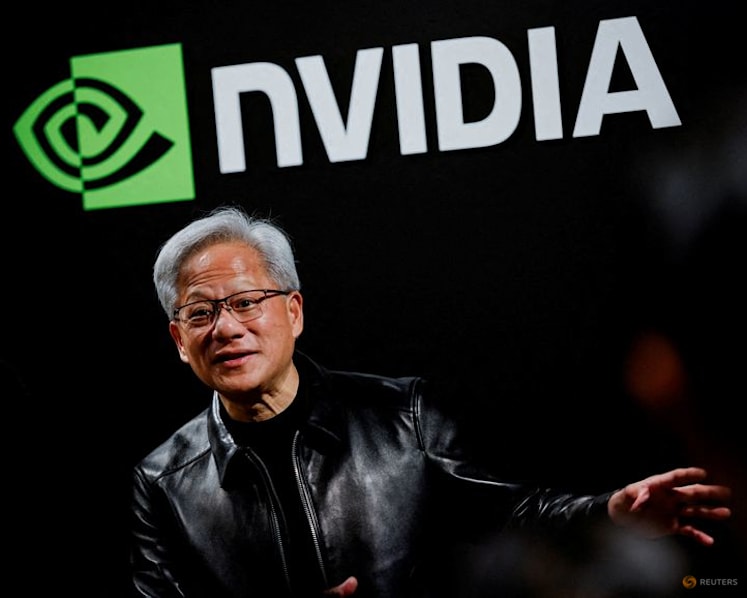 | Manami Yamada / Reuters via CNA. Jensen Huang, archive.
Nvidia’s board met Wednesday to discuss CEO Jensen Huang’s future, Reuters reported. Shares fell in extended trading after reports that the board was preparing to remove him. No removal had been announced in the reporting available for this edition. |
NVDA $158.69 · −8.66% at 8:28 a.m. ET. Premarket Thursday, versus Wednesday’s regular close.
Huang has acknowledged an affair with a former executive at Megaspeed, a Singapore-based data-center company. U.S. officials suspect the woman of working for Chinese intelligence, according to reporting. Nvidia’s board has opened an independent investigation. Megaspeed says it will cooperate with investigations into potential national-security risks.
On Sunday, the board said it had no reason to believe Nvidia secrets or national security had been compromised and expressed confidence in Huang. That statement preceded the latest reports about the board’s discussions. Neither the investigation nor those reports establishes that a breach occurred.
Huang co-founded Nvidia and has led it for more than three decades. Investors associate him with its hardware roadmap, software ecosystem and relationships with major customers.
There is a counterweight to the panic: Nvidia’s engineers, products, customer contracts and manufacturing relationships do not disappear if a CEO leaves. The company generated $96.2 billion in revenue last quarter, including $89 billion from data centers. Demand for its systems is a separate question from the investigation.
Nvidia is also a major index holding, so the selloff reaches investors who never bought the stock directly.
|
|
Nebius beats estimates. Its $27 billion buildout gets bigger. |  | Nebius data center, Finland, archive.
Nebius reported Q3 revenue of $980.8 million, above a $916.8 million Zacks estimate, and a GAAP loss of $0.13 per share. It now expects 2026 revenue at the low end of its $3.0 billion–$3.4 billion range as some capacity moves into 2027. |
NBIS $131.40 · −15.06% at 8:28 a.m. ET. Premarket Thursday, versus Wednesday’s regular close.
| Metric | Reported / outlook | Prior estimate |
|---|
| Q3 revenue | $980.8M | $916.8M | | GAAP diluted EPS | −$0.13 | — | | 2026 revenue outlook | $3.0B–$3.4B, low end | — |
Revenue estimate last changed October 22. GAAP EPS is not compared with adjusted consensus. Data provided by Zacks Investment Research, Inc., www.zacksdata.com.
The headline growth is extraordinary: quarterly revenue increased 571% from $146.1 million a year earlier and rose from $582.3 million in Q2. Adjusted EBITDA reached $465.8 million, while the company reported a $37.5 million net loss. EBITDA excludes costs including depreciation and interest; it is not cash left after building a data center.
The uncomfortable part arrives in the cash-flow statement. Nebius used $273 million in operating cash during the quarter and spent $7.3 billion on property, equipment and intangible assets. The spending buys capacity intended to generate revenue over years. It also has to be financed now.
Management lifted its 2026 capital-spending outlook to approximately $27 billion from $20 billion–$25 billion. It expects more than $7 billion in annualized run-rate revenue in February rather than its earlier $7 billion–$9 billion target for December, because some third-party capacity is arriving later.
A run rate annualizes one month of activity; it is not revenue already earned over a full year. Delayed capacity shifts when customers can use equipment and when Nebius can recognize sales.
For 2027, the company forecasts $12 billion–$13 billion of revenue, $40 billion–$45 billion of capital spending and pre-tax breakeven in the fourth quarter. Management expects prepayments and asset-backed financing to cover 75%–85% of planned spending. Those are targets, not funding already received or a promise of profit for the full year.
There is genuine demand behind the expansion: customers have committed to capacity and paid in advance. Nine-month operating cash flow was positive $4.23 billion, helped by prepayments. The question for shareholders is whether new sites come online on schedule and generate enough cash to support borrowing, equipment replacement and further expansion.
|
|
Lilly gets a China approval. Pfizer pays to catch up. |  | Eli Lilly corporate center; Getty Images via ABC News.
China approved Eli Lilly’s oral weight-loss drug orforglipron, according to Reuters. Pfizer, meanwhile, struck a deal under which Blackstone could fund up to $1.5 billion of development costs for an experimental monthly obesity treatment. |
LLY $1,462.00 · +1.72% at 8:26 a.m. ET. Premarket Thursday, versus Wednesday’s regular close.
Lilly is the first company to win Chinese approval for a GLP-1 weight-loss pill, Reuters reported. Novo Nordisk has applied to sell oral Wegovy there but has not yet received approval. Lilly did not immediately say when its pill would launch in China or what it would charge.
A pill may appeal to people who do not want injections. The commercial opportunity still depends on price, availability, manufacturing capacity and reimbursement. Approval opens a market; it does not tell investors how many prescriptions the company will sell or what margin it will earn.
Pfizer’s agreement is at a different stage. Blackstone Life Sciences will help fund development of berobenatide through 2028. In exchange it may receive milestone payments tied to U.S. regulatory approval of the monthly treatment and sales targets. The drug remains investigational.
For Pfizer, outside capital can reduce trial spending while giving a partner potential future payments. The funding ceiling is not drug revenue.
Lilly already has a product with an approval; Pfizer is still trying to bring a competitor through development. The distinction matters to investors looking at the same obesity-drug market and very different timelines.
|
|
Intuitive Machines turns more contracts into cash. |  | Intuitive Machines facility, Houston.
Intuitive Machines reported Q3 revenue of $269.3 million, above MarketBeat’s $245.9 million estimate, and a GAAP loss of $0.02 per share. It forecasts $920 million–$950 million of full-year revenue and positive adjusted EBITDA. |
LUNR $13.83 · +13.55% at 8:28 a.m. ET. Premarket Thursday, versus Wednesday’s regular close.
| Metric | Reported / outlook | Estimate |
|---|
| Q3 revenue | $269.3M | $245.9M | | GAAP diluted EPS | −$0.02 | — | | 2026 revenue outlook | $920M–$950M | — |
Revenue estimate: MarketBeat.
Revenue rose from $52.4 million a year earlier, helped by satellite production, lunar delivery and communications work. Acquisitions also expanded the business, so the increase is not a clean measure of organic growth from the same company it owned a year ago.
The company generated $66.2 million of operating cash and spent $32.7 million on property and equipment, leaving roughly $33.5 million of free cash flow for the quarter. Across the first nine months, however, operating cash flow was negative $45.7 million. A single strong quarter does not yet establish a full-year cash-generation pattern.
Gross profit was $69 million, or about 26% of revenue. Management said the result benefited from higher volume and favorable one-time program and cost-estimate adjustments. Investors should not assume all of that quarterly margin will repeat.
The net loss narrowed to $3.4 million, but the income statement also included a $30 million gain from changes in the value of warrant liabilities. The operating loss was $34.2 million. Those numbers explain why a small net loss does not necessarily mean the underlying business is already operating at breakeven.
Backlog reached $1.9 billion, including acquired backlog. It represents work the company expects to perform, not cash collected today. Intuitive Machines also became a vendor under a NASA contract with a large overall ceiling; that ceiling is not a guaranteed award to Intuitive Machines alone.
Management is targeting the IM-3 mission and Altus-1 lunar satellite for a March/April launch. The next test is turning more of the awarded work into deliveries and repeatable margins without relying on favorable adjustments.
|
|
|


