SAP had 2,346 more full-time-equivalent employees in September than a year earlier. On Thanksgiving, Bloomberg reported that the software company was preparing to cut at least 10,000 positions. SAP’s accounts offer a clue to what management might want to change. Cloud subscriptions are growing, while revenue from selling and supporting traditional software is shrinking.
Adobe expects Black Friday’s average TV discount to reach 23%, up from 11% earlier in November. On a $1,000 set, that would save a shopper another $120. How much of that discount Best Buy pays for depends partly on its suppliers.
China’s chip-heavy STAR 50 jumped 15% on Friday after Beijing called for state-backed investors to play a bigger role in stabilizing the stock market. In Taiwan, demand for AI hardware helped lift the government’s 2026 economic growth forecast from 11.05% to 13.28%. Officials made a smaller increase for 2027, from 6.04% to 6.51%.
U.S. stock exchanges close at 1 p.m. Eastern today. Before the Thanksgiving break, Nutanix fell 15% after reporting a profit beat and announcing a CEO search.
Introducing Cash & Chaos ETFsHow much Nvidia do you own through your index funds? Our new sister newsletter, Cash & Chaos ETFs, looks inside funds to show where their holdings overlap, which stocks drive their returns and what you pay in fees.
|
|
SAP weighs cutting 10,000 jobs while its cloud sales grow 26% |  | SAP’s campus in Walldorf, Germany. Archive photo by Vladislav Bezrukov from Walldorf, Germany, Wikimedia Commons. CC BY 2.0. License
SAP sells software that companies use to run payroll, buy supplies and close their books. The people who built and sold licenses for those systems helped create a business that still took in €2.58 billion from licenses and support last quarter. But that revenue fell 5% from a year earlier. Cloud subscriptions brought in €6.67 billion, up from €5.29 billion. SAP’s Cloud ERP Suite, which includes the software customers use to manage those operations, accounted for €1.34 billion of the €1.38 billion increase. That one suite supplied 97% of the year-over-year growth in cloud revenue.
That is the backdrop to Bloomberg’s report Thursday that SAP is drawing up plans to eliminate at least 10,000 positions, with product development, engineering and sales under scrutiny as it incorporates AI into its software. SAP told Bloomberg that it regularly reviews its organization and declined to confirm cuts. The reported figure amounts to about 9% of the 113,076 full-time equivalents SAP recorded at September 30. On Friday, two people familiar with the plans told Reuters that SAP was preparing sizable cuts. One said SAP had yet to inform its works council.
| SAP, September quarter | 2025 | 2026 |
|---|
| Cloud revenue | €5.29B | €6.67B | | Licenses and support | €2.73B | €2.58B | | Total revenue | €9.08B | €10.27B |
Source: SAP quarterly statement. Figures in euros at reported exchange rates.
When it announced its 2024 restructuring, management expected to finish the year with roughly the same headcount because it intended to reinvest in other jobs. To estimate the savings this time, shareholders would need to know what SAP would pay in severance, how much payroll it would save each year and how much it would spend hiring elsewhere.
Customers had committed to €24.1 billion of cloud revenue that SAP expects to recognize over the next 12 months, up 28% year over year. A customer moving its finance system to the cloud may need help transferring records, testing processes and training staff before it can go live. A smaller team that completes those jobs on time can improve the economics of each contract. A team that leaves customers waiting can also postpone the next sale. SAP’s next results can put a number on the cost of any plan it adopts. Its backlog and cloud sales over the following quarters will show how well it keeps delivering through the change.
SAP also told German news agency dpa that it had detected suspicious activity and taken steps to protect customers. As of Thursday evening, the company said its investigation had found no evidence that anyone had gained unauthorized access to customers’ business data.
|
|
Software caught chips. Even the cybersecurity leaders fell in November. | 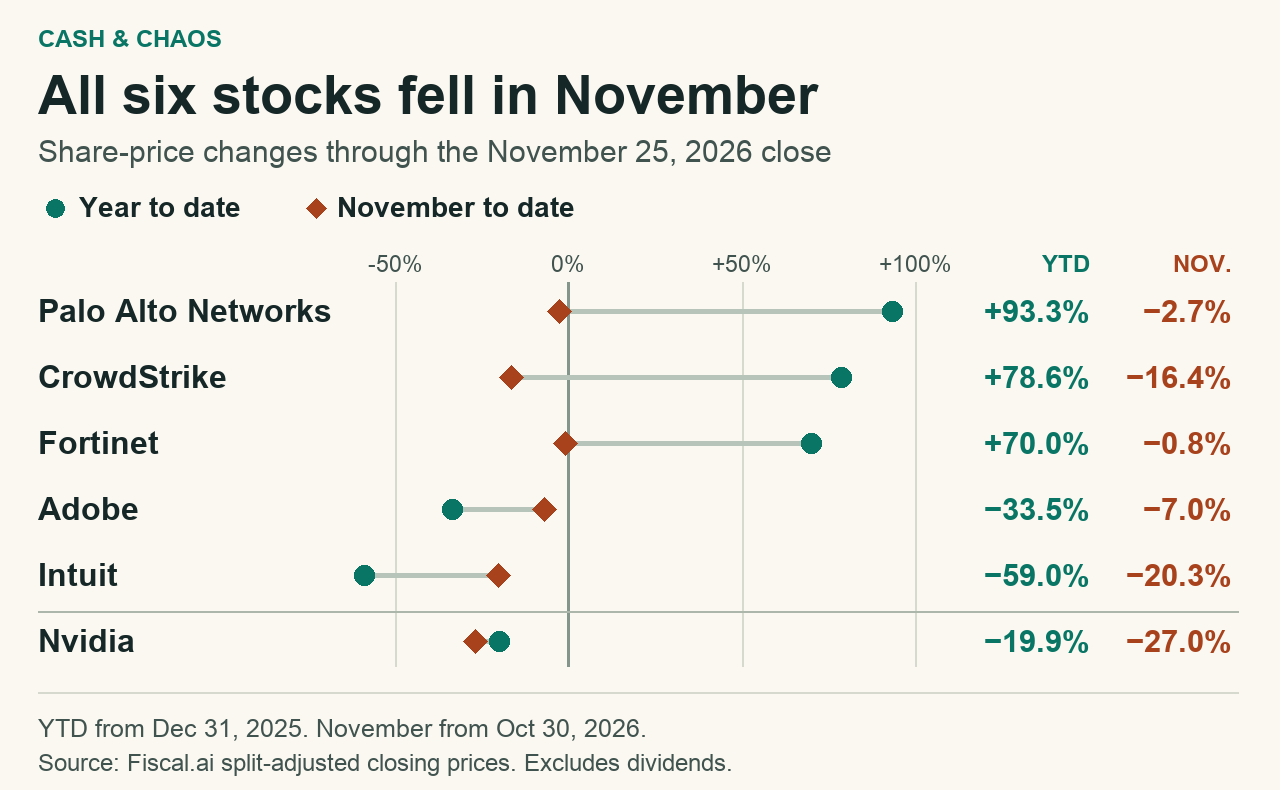 | Five software stocks and Nvidia. Chart by Cash & Chaos using Fiscal.ai closing prices.
As recently as October, the S&P 500 semiconductor sub-index was roughly 45% above where it began the year. By Thanksgiving, that gain was gone. The S&P 500 software sub-index had edged ahead, with both groups down for the year, according to Bloomberg data charted by the Financial Times. Of the 22 software stocks shown, just nine were up.
The three biggest winners sold cybersecurity. Through Wednesday’s close, Palo Alto Networks had gained 93% for the year, CrowdStrike 79% and Fortinet 70%. Move the starting date to October 30 and all three lost money. CrowdStrike fell 16% over that stretch, even as it reported that annual recurring revenue grew 27% to $6.26 billion. Nvidia fell 27% over the same trading days.
Intuit shows how little that index crossover tells an investor about an individual software business. Its October-quarter revenue rose 12% to $4.35 billion. Its shares still ended Wednesday 59% below last year’s close. An investor who owned Intuit all year did substantially worse than one who owned Nvidia, even as software pulled ahead of chips.
|
|
Black Friday’s early winners include toothpaste and detergent. Best Buy is counting on TVs. |  | Powhusku from Laramie, WY, USA. Black Friday shoppers, archive photograph. Wikimedia Commons. License
Online sales of personal hygiene products ran 40% above their October daily average from November 1 through 22, according to Adobe figures reported by the Associated Press. Household cleaning supplies rose 33% on the same comparison, clothing basics 27%. Someone buying two months of detergent on sale gives the retailer cash today and has one less reason to come back for detergent in December.
For Best Buy, a manufacturer-funded TV discount can bring a shopper into the store while protecting the retailer’s margin. If Best Buy has to match a rival’s price out of its own pocket, the same sale leaves it with less gross profit.
U.S. shoppers spent $82.5 billion online from November 1 through 22, up 9.1% from the same period last year, according to Adobe. For Black Friday alone, Adobe forecasts $12.9 billion, up 9.2%. Its forecast assumes spending grows at almost the same pace shoppers had already set before Thanksgiving. Best Buy has given shareholders a more specific benchmark for the holiday quarter. It expects comparable sales growth of 2% to 4% and an adjusted operating margin of 4.9% to 5.1%.
Last quarter shows why those measures belong together. Best Buy’s U.S. gross margin rose from 23.3% to 24.1% even as margins on the products themselves fell. A $41 million tariff refund accounted for roughly 0.44 percentage points on $9.4 billion of domestic revenue. Advertising and the third-party marketplace also helped. The latest U.S. tariff proposals cover imports from 14 economies. Hearings begin January 25, making those duties a question for retailers restocking after the holidays.
How shoppers find a TV matters to that advertising business. Adobe says visits to retail sites from AI tools more than doubled this November from a year earlier. A shopper who asks an assistant to compare two TVs could land directly on Best Buy’s product page, skipping the search results where a rival brand might have paid to appear. Best Buy could still sell the TV. Adobe’s figures count visits across retailers and leave open how many ended in a purchase at Best Buy.
|
|
Nutanix fell 15% after earnings. Its next-quarter margin explains some of the caution. |  | Server racks in a data center, archive photograph. Carl Lender from Sunrise, USA / Wikimedia Commons, CC BY 2.0. License
Nutanix, whose software lets companies manage servers and storage across their own facilities and the cloud, reported $772.4 million in fiscal first-quarter revenue and 73 cents in adjusted diluted earnings per share Tuesday. Revenue beat the Zacks consensus by 1.3%, and analysts had expected 60 cents per share. For the quarter ending in January, management expects $820 million to $830 million of revenue and an adjusted operating margin of 27% to 28%.
At the midpoints, Nutanix would sell about $53 million more software and services than in the October quarter, yet earn about $227 million of adjusted operating profit, down from $248 million. Its October adjusted margin reached 32.1%, up from 19.7% a year earlier. Carrying that unusually profitable quarter forward would put the earnings estimate about $38 million above what the January midpoint implies.
| Nutanix | October actual | January outlook |
|---|
| Revenue | $772.4M | $820M–$830M | | Adjusted operating margin | 32.1% | 27%–28% |
Source: Nutanix. Pre-results consensus cited above reported November 24. Data provided by Zacks Investment Research, Inc., www.zacksdata.com.
Cash generation also improved. Nutanix took in $219.9 million from operations and had $209.3 million left after capital spending. Its $2.63 billion annual recurring revenue figure measures the yearly value of subscriptions in force, assuming renewal on existing terms.
The board announced a search for CEO Rajiv Ramaswami’s successor alongside the results. He plans to stay until the next chief takes over. The shares finished Wednesday at $46.30, down 15.2% from Tuesday’s regular close. Investors got the margin forecast and the succession news together. The trading price measures their combined reaction and leaves little basis for assigning the drop to either announcement alone.
|
|
Apple pulled Talkie. MiniMax’s accounts show how much its business has changed. |  | Apple’s Fifth Avenue store in New York. Archive photo by Jorge Láscar from Australia, Wikimedia Commons. CC BY 2.0. License
Apple removed MiniMax’s Talkie chatbot from its App Store worldwide after reports that AI characters had sent sexualized messages to minors, Reuters reported Thursday. Talkie carried an adult age rating. Child-safety advocates told Reuters that users could enter their own age. Apple and MiniMax did not immediately respond to Reuters’ requests for comment.
The removal cuts off an important way for new iPhone users to find and install the app. Talkie had roughly 11 million monthly users across its app and website in October, according to research firm Unique. That figure includes people using it outside Apple’s store. Multiplying 11 million by a subscription price would also count free users as paying customers.
MiniMax’s Hong Kong filing offers a better starting point. In the first half of 2025, its own AI products generated $21.2 million, nearly 70% of revenue. A year later that business had doubled to $42.6 million. Over the same period, revenue from its open platform and other enterprise services jumped from $9.2 million to $73.9 million. The products business had grown in dollars and shrunk to 36.6% of the company.
Talkie shares that $42.6 million category with other products, including MiniMax’s video tool Hailuo. MiniMax does not give a current revenue figure for Talkie on iPhones. The business most directly exposed is the one that needs consumers to keep discovering and paying for its apps. Its much larger platform business collects revenue when developers and other customers use its models.
|
|
|


