Coolcaesar · edit by Jacek Halicki / Wikimedia. Nvidia headquarters, archive. CC BY-SA 4.0
For its fiscal third quarter, Nvidia reported $115.84 billion in revenue and $2.68 in adjusted diluted earnings per share. Both beat expectations. Management put fourth-quarter revenue at $130 billion, plus or minus 3%, in a quarter with an extra week. The forecast assumes zero China data-center compute revenue. Licensed Hopper shipments to China had supplied $2.4 billion the quarter before.
| Nvidia · Q3 FY27 | Actual | Estimate |
|---|
| Revenue | $115.84B | $108.19B | | Adjusted diluted EPS | $2.68 | $2.50 |
Quarter ended October 25. Pre-results consensus dated November 16. GAAP diluted EPS was $2.70. Data provided by Zacks Investment Research, Inc., www.zacksdata.com.
One reason the guidance held up was that the next generation of chips was already shipping. Vera Rubin generated nearly $20 billion in its first quarter of production shipments. Yet Nvidia expects gross margin of 71% to 72% next quarter, down from a 74.9% adjusted margin. Customers who locked in orders before component costs rose will receive their chips on the agreed terms. Nvidia absorbs some of the increase.
The cost of securing future supply is visible before those chips reach a customer. Nvidia’s supply commitments rose from $279 billion to $390 billion, largely on multiyear memory purchases. Reserving scarce memory helps it deliver systems on schedule. If demand softens while those contracts are in force, suppliers still have a claim on Nvidia. Nvidia’s CFO commentary
There is a second commitment on the customer side. Nvidia disclosed $118 billion of maximum gross guarantee exposure, including $105 billion of credit support linked to SB Energy’s Ohio campus. The guarantees begin in phases as buildings become ready. Nvidia reported no payments under them. For a shareholder, the distinction is between cash already spent and a promise that could become expensive if a customer project struggles. Adding the two kinds of commitment together as debt would obscure when and why either one could cost money.
Friday brought another reason for caution. Reuters reported that SEC enforcement staff were examining potential accounting issues at Nvidia. Its sources did not identify the accounting practices under examination. Separately, California’s attorney general subpoenaed Nvidia over disclosures related to advanced chips and their diversion to China. Zero China compute revenue in a forecast tells investors how Nvidia built next quarter’s estimate. It leaves the historical disclosure questions open. Nvidia fell 14.01% Friday. Reuters reporting · California subpoena
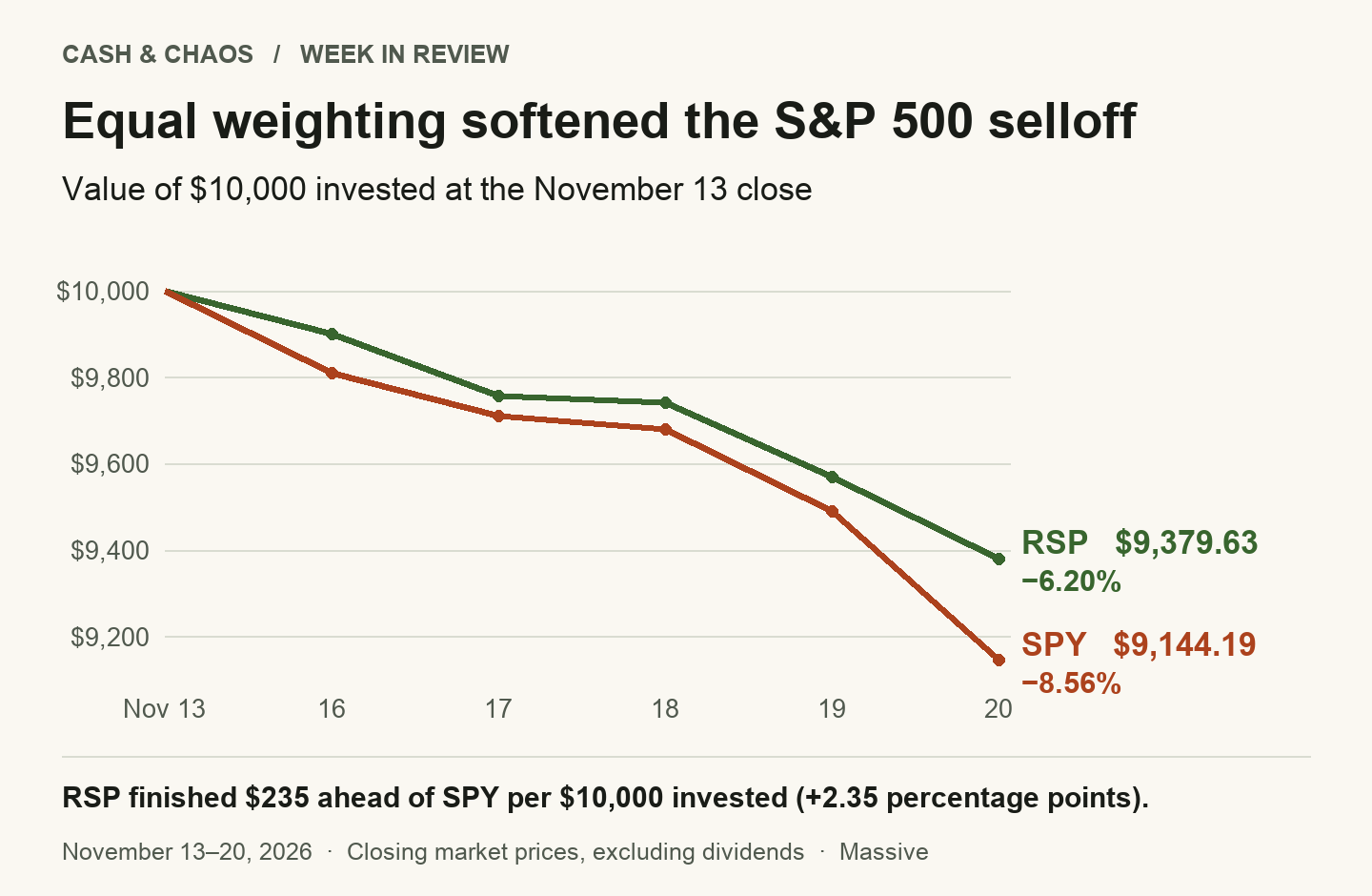 SPY and RSP closing market prices, November 13–20. Each starts at $10,000. Dividends excluded. Source: Massive.
A $10,000 investment in SPY at the November 13 close finished Friday worth $9,144. The same investment in RSP finished at $9,380, before dividends. Both funds own the S&P 500 companies. SPY gives the most valuable companies the largest positions. RSP restores roughly equal weights at its quarterly rebalance. Owning less of the largest names cushioned the loss, although the equal-weight investor still lost about $620.
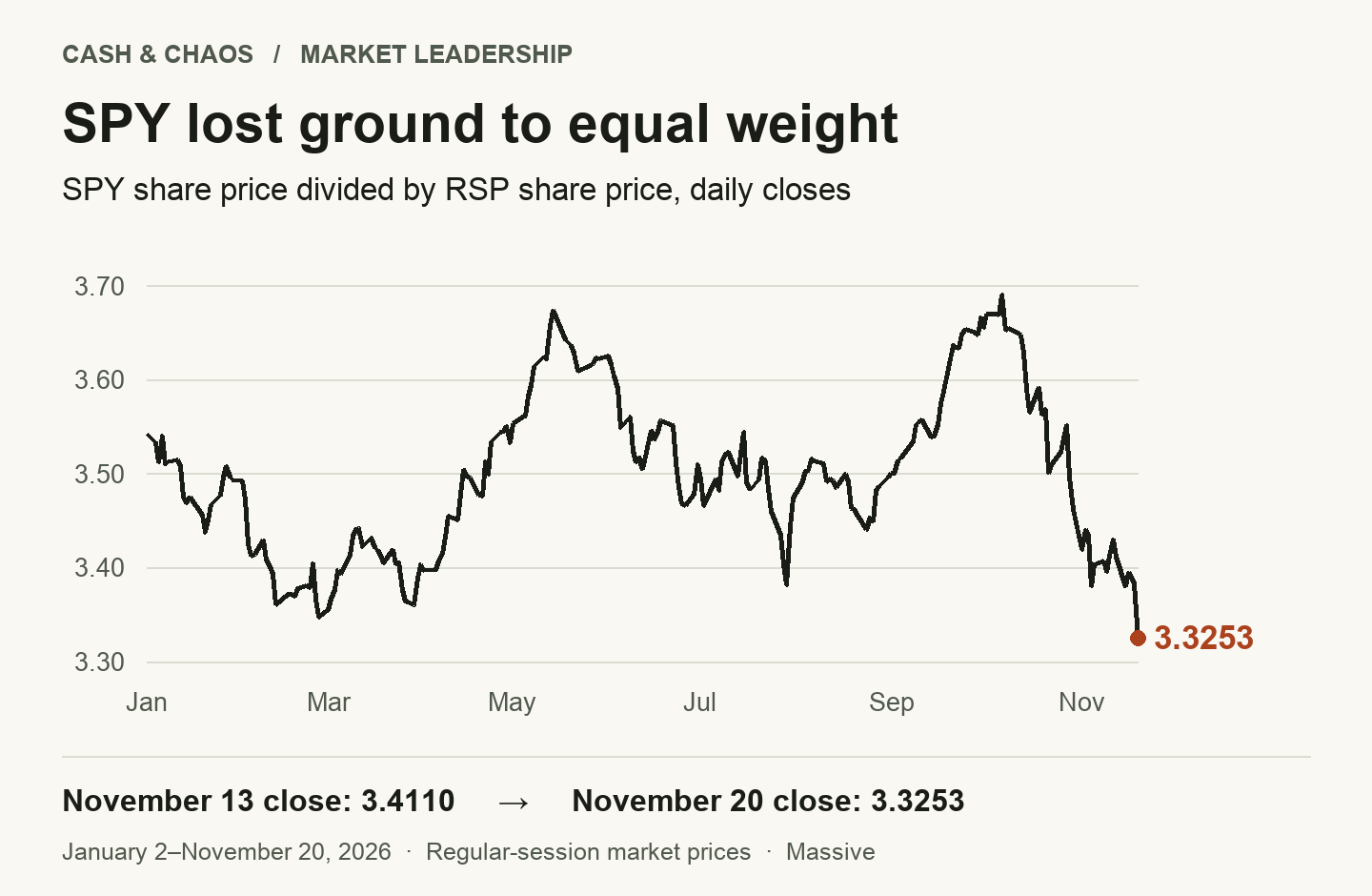 SPY closing price divided by RSP closing price, January 2 to November 20. A falling line means RSP outperformed. Source: Massive.
At 12:18 p.m. ET Friday, with the equal-weight S&P 500 ETF trading at $210.53, Fundstrat’s Mark Newton identified $207–$208 as an area where buyers might step in. RSP traded as low as $206.86 and closed at $207.44, inside that range. It still lost 6.2% for the week. Investors who gave each company roughly equal weight took a smaller hit than investors in the traditional S&P 500 fund, which fell 8.6%. Fundstrat’s weekly review
The losses were uneven even among the biggest names. From November 13 to 20, Micron fell 23.62%, Nvidia 22.92%, AMD 20.54% and Broadcom 12.28%. Meta fell 12.60%, Tesla 11.38%, Alphabet Class A 10.31%, Microsoft 7.51%, Amazon 7.44% and Apple 3.85%. Bloomberg reported that the Nasdaq 100 had its worst week since March 2020. An investor holding both chipmakers and Apple through SPY bore each loss in proportion to the size of the holding. Bloomberg’s market wrap
|