Nvidia shares jumped 31.5% on Monday after Jensen Huang returned as CEO. By Tuesday morning, Singapore’s prime minister had confirmed his government was still investigating one of Nvidia’s customers. December’s hearings now give lawmakers a chance to ask Huang how far Nvidia can follow a chip after a distributor sells it.
Hewlett Packard Enterprise returned 51 cents of every dollar of quarterly free cash flow to shareholders. In September it had aimed for at least 75 cents. Amazon is trying to get more out of the chips it has already built, starting with software that can edit a video while the camera is still rolling.
At 8:20 a.m. Eastern, S&P 500 futures traded at 7,159.75, down 1.31% from the previous close. Nasdaq-100 futures fell 2.18% to 26,224. Bitcoin traded at $60,033 at 8:30 a.m. Eastern, down 5.89% over 24 hours.
Best Buy raised its full-year comparable-sales growth forecast to 3.4%–4.0% after reporting 6.1% growth in its third quarter, which ended before Black Friday. Analog Devices reported $4.37 billion in fiscal fourth-quarter revenue and $4.06 in adjusted diluted earnings per share. It expects about $4.4 billion in first-quarter revenue, give or take $150 million. Dell reports after the close.
|
|
Jensen Huang is back. Who uses Nvidia’s chips? |  | Coolcaesar; edit by Jacek Halicki / Wikimedia. Nvidia headquarters, archive. License
Nvidia’s board reinstated Jensen Huang as president, CEO and a director effective November 22. Its independent investigation continues. On Monday, the U.S. Commerce Department filed a rule putting seven entities, including Megaspeed, on its export-control list. On Tuesday, Singapore’s Prime Minister Lawrence Wong said investigators there are examining whether Megaspeed broke Singapore law. Megaspeed says it complies with U.S. export controls.
Malaysia’s trade ministry said Tuesday it would advise data centers against leasing space or providing services to any of the seven companies named by U.S. Commerce. One is Apex Enterprise Solutions, an Alibaba subsidiary in Singapore. Alibaba told The Straits Times that the listing was a mistake and denied that Apex had diverted chips subject to U.S. export restrictions. A delivery receipt can establish where a distributor sent a server. Six months later the same machine can be running jobs for a different customer, with no new shipment for customs to inspect.
Nvidia has given its national security and trade compliance teams a direct line to a board committee chaired by Suzanne Nora Johnson. The directors plan to meet at least quarterly and retain outside experts. That gives staff a way to raise an objection above the sales team. The committee’s charter leaves a day-to-day decision unresolved. If a distributor identifies the owner of the hardware but cannot identify the customer renting it, who at Nvidia can hold the next order?
Nvidia’s $130 billion fourth-quarter revenue forecast already assumes zero sales of data-center computing chips in China. In its fiscal third quarter it shipped $2.4 billion of Hopper data-center products to China. Subtracting that $2.4 billion again would count the same risk twice. A delay at a customer elsewhere in Asia is different. An order Nvidia expected to fill this quarter could slip while the parties establish who will use the machines.
Nvidia gained 31.48% to $165.05 on Monday, its biggest one-day rise since 2003. Bloomberg’s figures put its contribution at about 110 points out of the S&P 500’s 326.78-point gain. One stock accounted for roughly a third of the rally. The advance reached beyond chipmakers, too. The equal-weight S&P 500 ETF gained 2.59%. The cap-weighted fund rose 4.71%, a difference of about $212 on a $10,000 starting investment.
Huang and general counsel Tim Teter are scheduled for separate transcribed House interviews on December 1 and 2. Huang appears before Senate Banking in public on December 3 at 10 a.m. Eastern. Lawmakers could ask for a redacted order that compliance staff actually paused. The customer records, the date of the objection and the name of the executive who signed off would tell shareholders more about how the new reporting line works than the names on the committee.
|
|
HPE planned to return 75 cents per dollar of free cash flow. It returned 51. |  | Hewlett Packard Enterprise headquarters, archive. Wikimedia Commons. CC0. License
Hewlett Packard Enterprise reported $14.55 billion in fiscal fourth-quarter revenue and $1.43 in adjusted diluted earnings per share, above the estimates below. For its first quarter, HPE expects $14.0 billion to $14.6 billion in revenue and $1.30 to $1.40 in adjusted EPS. In September, management said it planned to return at least three-quarters of the fourth quarter’s free cash flow to shareholders.
| HPE fiscal Q4 | Reported | Analyst estimate |
|---|
| Revenue | $14.55B | $14.45B | | Adjusted diluted EPS | $1.43 | $1.29 |
Pre-results estimates dated November 20 for revenue and November 19 for EPS. Data provided by Zacks Investment Research, Inc., www.zacksdata.com.
HPE generated $1.915 billion in fourth-quarter free cash flow and paid $979 million in common dividends and share repurchases. That works out to 51.1%. At the 75% target, capital returns would have been about $1.44 billion, roughly $457 million more. Full-year free cash flow reached about $4.5 billion, above September’s $3.75 billion floor. Cash generation held up better than the quarterly payout.
For fiscal 2027, HPE expects at least $5.5 billion of free cash flow and aims to return at least 75% to shareholders. At those two floors, dividends and buybacks would total about $4.13 billion. The company is targeting roughly $3 billion of buybacks for the year. The board’s additional $5 billion authorization brings its total repurchase authority to about $7.3 billion, which management can use over time.
Shareholders already know what the next dividend will pay. The board declared 17 cents per common share for January 8, up from 14.25 cents the previous quarter. Someone holding 100 shares on the December 9 record date is due $17. Most of the planned capital return takes a different route. A buyback pays the investors who sell to HPE and can increase the fraction of the business owned by those who stay.
Dell reports after Tuesday’s close. HPE’s Cloud & AI division earned an 18.4% operating margin on $11.3 billion of quarterly sales. HPE expects sales in that division to grow 30%–40% in fiscal 2027 at a margin of about 14%, so it anticipates keeping fewer cents of operating profit per sales dollar even as orders grow. The division includes storage and financing alongside servers. For Dell, the cleanest comparison is its own shipment forecast. After the first half, it needed $41.47 billion of AI-server revenue across the last two quarters to reach its $74 billion annual target. Tuesday’s report will show how much still rests on the final quarter.
|
|
Amazon agrees to buy the software behind its live AI video demo | 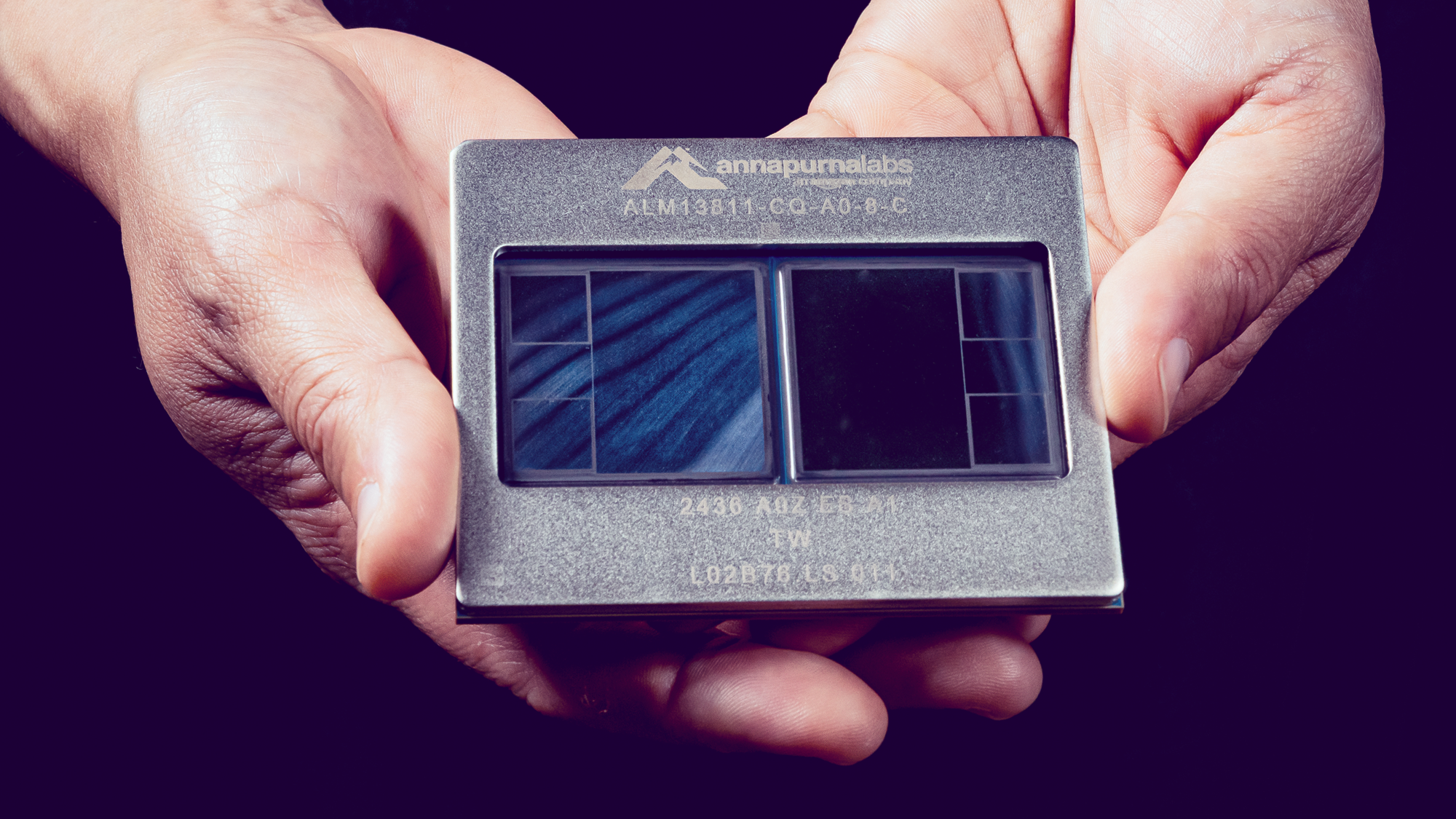 | AWS Trainium2 chip. Photograph courtesy of Amazon.
Amazon agreed to buy Decart’s optimization technology and bring its three co-founders, engineers and researchers into the company. The teams have worked together since 2025. Amazon disclosed no price, and the agreement still needs regulatory clearance. AWS already offered Decart’s video tools through its marketplace.
Decart’s Lucy model can change the background of a live camera feed as a person moves through the frame. At Amazon’s 2025 developer conference, Decart showed it running on Trainium3, an Amazon-designed chip. AWS said the demonstration achieved roughly four times the frame rate of the GPU comparison it used. Decart’s research site puts Lucy’s throughput on Trainium at as many as 101 frames a second. Those figures describe one model and one kind of work.
For a retailer offering a virtual try-on, a convincing still image solves only part of the problem. If a shopper turns, the software has to keep the garment in place in the next frame. At 30 frames a second, a new frame is due roughly every 33 milliseconds. Frames delivered late spoil the experience even if the system generates plenty of them over a full minute. A retailer deciding whether to switch chips has to price a minute of usable video, including the quality it needs at busy times.
Amazon has already paid to design Trainium and install it in data centers. If better software lets one installed chip handle more paying streams, AWS can spread that investment across more billable minutes. Customers renting a chip by the hour could pocket some of the savings themselves by finishing sooner. Which side keeps the benefit depends on how AWS charges and whether customers use the freed capacity.
The deal also takes the engineers beyond a single video application. Amazon says it wants their work to reach its own models as well as its chips. A text service has different demands. Customers care how long the first word takes to appear and how quickly the rest follows. Amazon has disclosed neither savings across those workloads nor a purchase price against which shareholders could measure them.
|
|
Zscaler shares ended $7.94 below the value of CrowdStrike’s offer |  | CrowdStrike’s former headquarters in Sunnyvale, California, photographed in 2024. Coolcaesar / Wikimedia Commons. CC BY 4.0. License
Zscaler closed Monday at $229.24. CrowdStrike closed at $208.97. Under the merger agreement, one Zscaler share converts into 1.135 CrowdStrike shares if the deal closes. At Monday’s prices, that basket was worth $237.18, leaving a gap of $7.94 per Zscaler share, or 3.46% of its closing price.
On Friday’s prices, the announced exchange ratio had put Zscaler at $260.41 a share. By Monday’s close, the same contract was worth $23.23 less per share. Zscaler itself still rose from Friday’s $194.82.
Consider 200 Zscaler shares, worth $45,848 at Monday’s close. They would convert to 227 CrowdStrike shares, then worth $47,436. A $10 fall in CrowdStrike would cut $2,270 from the value of those shares, more than the $1,588 gap between the two holdings. Zscaler shareholders still have to approve the deal, as do regulators. Founder Jay Chaudhry and affiliates holding about 34% have signed voting agreements in support. The companies expect closing in the second half of CrowdStrike’s fiscal 2028.
Zscaler holders are therefore being offered an interest in a business whose results also arrived Monday. CrowdStrike reported $1.58 billion of fiscal third-quarter revenue and $0.34 in adjusted diluted EPS. Fourth-quarter guidance calls for roughly $1.64 billion in revenue and $0.36 of adjusted EPS. Ending annual recurring revenue reached $6.26 billion, up 27%. That measure annualizes recurring subscriptions in place at quarter-end. Free cash flow, the cash the business generated after capital spending, rose to $474.4 million from $295.9 million a year earlier.
CrowdStrike generated about 30 cents of free cash flow for each dollar of quarterly revenue. Its GAAP operating result was close to break-even, a loss of $0.8 million, while adjusted operating income was $405.5 million. The measures treat expenses such as stock-based pay differently. A Zscaler owner accepting shares will participate in CrowdStrike’s future cash generation and share the cost of any dilution.
There is a concrete sales opportunity behind the exchange ratio. The companies already serve more than 2,000 customers in common. CrowdStrike counts another 8,000 Zscaler customers who could buy its products for the first time. Management’s target of $1 billion of additional annualized revenue by month 30 after closing depends on winning more business from those accounts and others. The voting agreements give management a head start on shareholder approval. They do nothing to shorten those customers’ purchasing cycles.
|
|
|