TUESDAY, OCTOBER 13, 2026  /  10-MINUTE READ

CASH & CHAOS

MARKETS, MONEY AND THE MADNESS IN BETWEEN.

Sponsored by

Good morning. Goldman’s equities business just put up a 72% revenue jump. UnitedHealth raised its profit outlook. And Visa finally has permission to start preparing a domestic business in China. Earnings season has given us something to work with.

Also inside: Microsoft’s plan to run more AI on its own chips, Disney’s bid for a piece of Character.ai, and a $300 million investment in the less glamorous business of checking that chips actually work.

BEFORE THE BELL

-0.09%S&P 500
7,851.00
-0.73%Nasdaq 100
30,672.00
+0.52%Dow
52,382.00

December futures · October 13, 7:26 a.m. ET · Delayed Yahoo Finance quotes; change versus prior close. Stock premarket snapshots below use the stated times.

01 / BANK EARNINGS

Goldman’s traders earned their bonuses.

Goldman Sachs headquarters in New York, archive photo

2009 archive. Z4dude / Wikimedia · public domain.

Goldman Sachs reported $17.01 a share in third-quarter earnings on $18.68 billion of revenue. Revenue rose 23% from a year earlier, topped the $16.87 billion Zacks consensus, and net earnings reached $5.29 billion. The standout was equities: $6.44 billion of revenue, up 72%.

Q3 resultsRevenueReported EPS
Goldman Sachs$18.68B$17.01
JPMorgan$50.17B$5.57
Wells Fargo$21.87B$1.87

Revenue and diluted EPS on reported accounting bases. JPMorgan revenue is reported net revenue, not its managed-revenue measure. USD.

Goldman revenue consensus: $16.87B, retrieved October 13; estimate last updated October 6. Data provided by Zacks Investment Research, Inc., www.zacksdata.com

Premarket: Goldman $918.00 (+2.69%) at 7:36 a.m. ET; JPMorgan $337.00 (+0.81%) at 7:36 a.m. ET; Wells Fargo $82.38 (-1.13%) at 7:36 a.m. ET. These are early snapshots, before the earnings calls.

Goldman’s equity financing and derivatives businesses drove that surge. Helping clients finance positions and trade around a volatile market can be lucrative even when buying and holding stocks feels much less rewarding.

Investment-banking fees added another $3.22 billion, up 21%, helped by completed mergers and stock offerings. Asset and wealth management produced $5.05 billion, up 14%. Fixed-income, currency and commodities revenue was roughly flat at $3.47 billion, so this was not a uniform surge across every trading desk.

The expense line moved too: operating costs rose 20% to $11.31 billion. Revenue grew faster, supporting an 18.7% annualized return on equity. Goldman also bought back $3 billion of shares during the quarter and declared a $5 quarterly dividend.

The wrinkle is the pipeline. Its investment-banking fee backlog fell from the previous quarter and was slightly below year-end 2025. A strong batch of completed deals pays today’s bills; replacing those deals determines how much fee income follows.

JPMorgan and Wells Fargo tell us more about the lending side. JPMorgan reported $27.04 billion of net interest income and $2.74 billion of credit provisions. Its adjusted EPS was $5.75, versus $5.57 reported. Wells Fargo generated $12.52 billion of net interest income and set aside $1.03 billion for credit losses. Provisions reduce current earnings to account for expected loan losses; they are not all cash losses incurred this quarter.

For Goldman, the immediate test is whether elevated client activity continues. For the lenders, listen for deposit costs, credit quality and the outlook for interest income. JPMorgan’s call is at 8:30 a.m. ET, Goldman’s at 9:30 and Wells Fargo’s at 10.

See Goldman’s trading, fees and expense breakdown →

The Mineral Everyone Forgets Until Their Driveway Freezes Over

Most people couldn't tell you what scandium is for, but everyone knows what happens when roads go unsalted. North America keeps running short, and Atlas Salt (TSXV: SALT) is building a shovel-ready mine in Newfoundland, three days by ship from Boston, with C$188 million in projected yearly free cash flow.

02 / HEALTHCARE · UNH

UnitedHealth raises the bar for the year.

UnitedHealthcare corporate headquarters, December 2024 archive

2024 archive. Chad Davis / Wikimedia · CC BY 2.0.

UnitedHealth lifted its full-year adjusted EPS outlook to at least $20.50, from $19.50–$20.00 previously. Third-quarter adjusted EPS was $4.69 on $112.7 billion of revenue. The stock traded at $387.00 (+2.24%) at 7:36 a.m. ET.

The insurance company’s medical-care ratio came in at 88.4%, versus 89.9% a year earlier. That measures how much premium revenue goes toward medical costs. A lower ratio leaves more room to cover administrative expenses and earn a profit.

There is an important contribution inside the improvement: $610 million of favorable prior-period reserve development, related to 2026 service dates. In plain English, some earlier claims are now expected to cost less than the company previously allowed for. That helps this quarter’s result, but should not be mistaken for a permanent reduction in the cost of every new claim.

UnitedHealthcare generated $2.8 billion of operating earnings; Optum contributed $3.7 billion. At the group level, operating earnings were $6.6 billion and operating cash flow was $5.1 billion. These business revenues overlap through internal transactions, so adding their sales together would overstate the group’s size.

The stronger outlook matters more than simply clearing a quarterly earnings estimate. Management is carrying the improvement into its forecast for the full year, while the reserve detail tells us to be careful about extrapolating the entire quarterly benefit.

For shareholders, the next useful evidence is how pricing and medical utilization develop together. Insurance premiums are set before the final bill for treatment is known. A company can grow enrollment and revenue while earning less if claims run ahead of what those premiums were designed to cover.

Today’s release offers a more encouraging view of that equation. The follow-through to watch is whether the underlying claims experience supports the higher earnings floor as the company moves into its next pricing cycle.

Check medical costs and the raised earnings outlook →

03 / PAYMENTS · V

Visa gets a way into China’s domestic market.

Visa San Francisco headquarters, August 2025 archive

2025 archive. Sarah Stierch / Wikimedia · public domain.

China has approved Visa’s application to prepare a domestic bankcard-clearing business. Visa shares traded at $395.42 (+1.58%) at 7:27 a.m. ET. The permission starts a regulatory process; it does not mean Visa can switch on domestic processing today.

The People’s Bank of China has allowed the company to begin formal preparations for a domestic clearing institution. AP reports that preparatory work must be completed within a year, after which Visa would need to apply to begin operating.

For a U.S. payments company, that is a meaningful opening. Domestic purchases create a different pool of potential business from transactions involving travelers or merchants across borders. Visa would be trying to win a place in payments that begin and end inside China.

The commercial work still comes after the regulatory milestone. Banks and merchants need reasons to use the network, and Visa has to build a business that earns more than it costs to establish and run. Access to a large market is valuable; the revenue depends on actual participation and payment volume.

Visa’s announcement provides no launch date, transaction-volume forecast or estimate of the earnings contribution. We would therefore treat this as an expansion of its future opportunity rather than a reason to pencil a sudden revenue jump into the next quarter.

The timing also gives investors a concrete corporate development to track alongside the broader U.S.–China trade relationship. The next milestones are operational approval and commercial partnerships. Those will tell us how much business follows the diplomatic progress.

Read what China’s approval allows Visa to do →

A CRM so smart, it updates itself.

HubSpot's CRM is so smart, it now updates itself. Calls get logged and summarized the moment they end. New leads get researched and a first outreach drafted, automatically. Deals move forward on their own, with next steps flagged before you have to ask. 

Even the one repetitive task you've been meaning to fix can now run itself, no code required. Customers using it are already seeing the difference. 

This isn't the CRM you have to work hard to figure out. It's the one already working before you log in.

MAG 7 + THREE

Where big tech finished

Monday, October 12 regular close · USD · Daily change. Mag 7 plus AMD, Broadcom and Micron; our editorial watchlist.

StockCloseChange
Apple$340.97+1.29%
Microsoft$541.15+1.14%
Nvidia$226.32-1.29%
Amazon$259.53-1.11%
Alphabet$352.72+0.30%
Meta$742.96+3.38%
Tesla$378.03-1.22%
AMD$594.24-2.28%
Broadcom$354.73-1.88%
Micron$989.04-3.88%

AI / MICROSOFT

Microsoft wants more Copilot answers running on its own chips.

Microsoft campus in Redmond, 2016 archive

2016 archive. Coolcaesar / Wikimedia · CC BY-SA 4.0.

Microsoft plans multi-gigawatt deployments of its Maia chips starting in 2027, making them the primary inference system for its own products and services. Maia 200 already handles production workloads including Copilot; GitHub Copilot and Microsoft Foundry are due to follow by year-end.

Inference is the work of running a trained model when somebody asks it to do something. Every answer has a computing cost. Serving more answers with the same power and hardware budget would help Microsoft’s economics as usage grows.

Maia 300 is due in 2027. Microsoft expects it to deliver 40% more tokens per megawatt than leading GPU-based systems. That is the company’s performance claim, rather than an independent comparison.

The announced scope is Microsoft’s own products and services. Azure customers still have different hardware and model needs. For Nvidia investors, the relevant pressure is a major customer developing alternatives for workloads it knows especially well.

Microsoft is taking on the cost of designing chips to gain more control over the cost of serving AI. Whether that pays off will show up in deployment, utilization and margins—not simply in how impressive the specifications look.

See which Microsoft services are moving to Maia →

AI / CHARACTER.AI · DISNEY

Disney offers $20 million as Character.ai heads to court.

Disney headquarters in Burbank, 2014 archive

2014 archive. Coolcaesar / Wikimedia · CC BY-SA 4.0.

Character.ai filed for Chapter 11 protection and agreed to a $20 million opening bid from a Disney affiliate for certain rights and assets. The proposed transaction also includes transition services.

The precise terms matter: Disney would receive a non-exclusive, perpetual license to certain intellectual property and certain claims. This is not an announced purchase of the entire Character.ai platform for $20 million.

Disney is the proposed “stalking horse” bidder—the initial offer against which better bids can compete in the court-supervised process. Character.ai expects the sale process and resulting transactions to finish in late November or early December.

The platform is expected to keep operating during that process. But the company says it will wind down if the sale does not produce a buyer that continues the service.

For Disney, the attraction is access to technology and rights through a defined transaction. For Character.ai users and creditors, the bigger unresolved question is who, if anyone, funds the platform’s continued operation. The $20 million headline alone does not answer that.

Read exactly what Disney’s opening bid includes →

CHIPS / TERADYNE · FORMFACTOR

Teradyne puts $300 million behind chip testing.

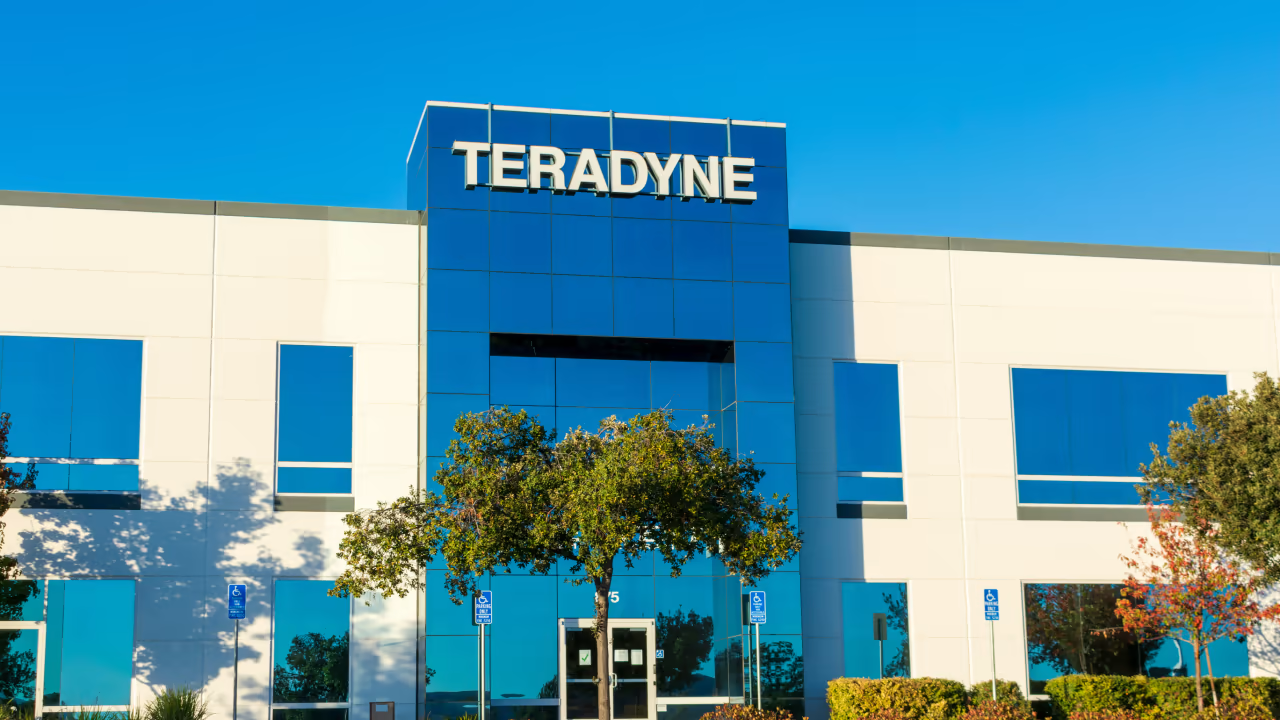
Teradyne office building

Teradyne offices.

Teradyne agreed to make a $300 million equity investment in FormFactor, alongside a collaboration announced after Monday’s close. The deal still requires customary closing conditions and regulatory approvals.

FormFactor supplies probing, interfaces and measurement technology; Teradyne makes automated testing equipment. Their plan is to help customers move increasingly complicated chips from development into high-volume production.

The target applications include advanced packaging, high-bandwidth memory and silicon photonics. These technologies need to work together reliably. Finding a defective component before it is built into a more expensive system can save the customer considerably more than the cost of the test.

The financial opportunity is in the equipment and services needed to support that production. The announcement gives us a capital commitment and a collaboration, but no new revenue forecast or guaranteed order total. Watch for customer deployments that turn the partnership into sales.

See the technologies covered by the agreement →

MACRO

Tomorrow, inflation gets its turn.

September CPI arrives Wednesday, October 14, at 8:30 a.m. ET. Producer prices follow Thursday at the same time. Today’s bank results tell us how companies earned money through September; these releases can change the interest-rate assumptions investors use to value the next few quarters.

For stock investors, watch the response in bond yields alongside the headline inflation number. Higher discount rates can weigh on richly valued growth companies even when their own sales are holding up. Save the official release calendar →

PREDICTION MARKETS

A pause still leads.

Polymarket’s October Fed contracts implied about 80.5% for no change and 18.5% for a quarter-point increase at the 7:36 a.m. ET check. These are market prices, not a Fed forecast; small probabilities were also assigned to other outcomes.

Follow the October rate-decision market →

UPGRADES / DOWNGRADES

The Street changes its mind.

RTX: Deutsche Bank cut its rating to Hold from Buy, with a $208 target. Reported October 13.

Adobe: HSBC cut Buy to Hold and its target to $267 from $310. The report published today describes the action as Monday’s. Read the reasoning.

A rating change is a change in the analyst’s recommendation. A price target is their valuation estimate; neither is a promised return.

CRYPTO SNAPSHOT

Bitcoin holds near $83,400.

Bitcoin $83,362 · Ether $2,501, from Coinbase spot prices retrieved at 7:36 a.m. ET. These are point-in-time prices, not daily returns.

Coinbase shares: $182.48 (+1.16%) at 7:32 a.m. ET premarket, versus Monday’s $180.39 close. For the stock, trading activity and the fees it generates matter alongside the direction of crypto prices. Check Coinbase’s Bitcoin market →

Forwarded this email? Get Cash & Chaos in your inbox.