Friday’s takeover talks turned into a signed deal Monday. CrowdStrike agreed to buy Zscaler in a stock swap valued at $43.9 billion. Zscaler shareholders now know how many CrowdStrike shares they would receive if it closes. What those shares will be worth can change every trading day.
At 8:18 a.m. Eastern Monday, S&P 500 futures traded at 7,113.50, up 2.57% from the previous close. Nasdaq-100 futures traded at 25,988.75, up 3.43%. The rebound follows a Friday selloff that took 14.01% off Nvidia’s share price. Tesla gained 4.9% from Friday’s close in premarket trading at 8:22 a.m. Eastern, and Elon Musk said over the weekend that he expects a wider December release of Tesla’s supervised driving software, which requires a driver’s attention. Musk’s update
At 9:45 a.m. Eastern, the first November surveys of U.S. factories and service businesses are due. Fundstrat’s Monday calendar shows expectations for both to grow more slowly, with manufacturing at 54.5 after 54.9 in October and services at 55.7 after 56.1. Readings above 50 indicate expansion. After the close, HPE reports how much cash it returned to shareholders, and Zoom reports whether the businesses already using its software spent more. New York Fed release calendar
|
|
CrowdStrike agrees to buy Zscaler. What will shareholders get? |  | CrowdStrike’s former headquarters in Sunnyvale, California, photographed in 2024. Coolcaesar / Wikimedia Commons. CC BY 4.0. License
Under Monday’s agreement, each Zscaler share would convert into 1.135 CrowdStrike shares. Friday’s closing prices show what that meant when the companies signed. CrowdStrike ended the week at $229.44, putting the offer at $260.41 per Zscaler share. Zscaler itself closed at $194.82. That difference gave shareholders a premium of about 34% and put the transaction’s enterprise value at $43.9 billion. Merger filing
The exchange ratio fixes the number of shares. A $10 decline in CrowdStrike would take $11.35 off the implied value of each Zscaler share even if the agreement stayed exactly as signed. A $10 rise would add the same amount. Existing CrowdStrike holders would own about 84.1% of the combined business and Zscaler holders about 15.9%. That gives both groups a stake in whether putting the two businesses together earns more per share.
CrowdStrike protects devices such as employee laptops. Zscaler checks which applications the people using those devices can reach. More than 2,000 customers already buy from both companies. For those customers, offering the products under one contract could simplify purchasing. It also means CrowdStrike must persuade a customer who already pays both bills to buy more before it can count an extra dollar of sales from that relationship.
Management put a timetable on two separate targets. By 30 months after closing, it expects additional sales from combining the businesses to be running at about $1 billion a year. It expects about $500 million in annual cost savings within 18 to 24 months after closing, partly by consolidating data-center and vendor spending. The first figure is revenue and the second is an expense reduction. Neither is cash collected on the day the deal closes.
The companies expect to close in the second half of CrowdStrike’s fiscal 2028. Zscaler shareholders must approve the deal, and regulators must clear it. Until then the companies operate separately, and investors can follow the market value of the offer by multiplying CrowdStrike’s share price by 1.135.
|
|
Treasury wants Nvidia to explain where its chips went |  | Coolcaesar; edit by Jacek Halicki / Wikimedia. Nvidia headquarters, archive. License
Scott Bessent said Sunday that the administration had contacted Nvidia’s interim management, lead directors and lawyers about possible failures in its export controls. The Treasury secretary wants to know how far up the company any knowledge reached. He left open whether the suspected diversion occurred. That distinction matters for a board that is also deciding who should run Nvidia.
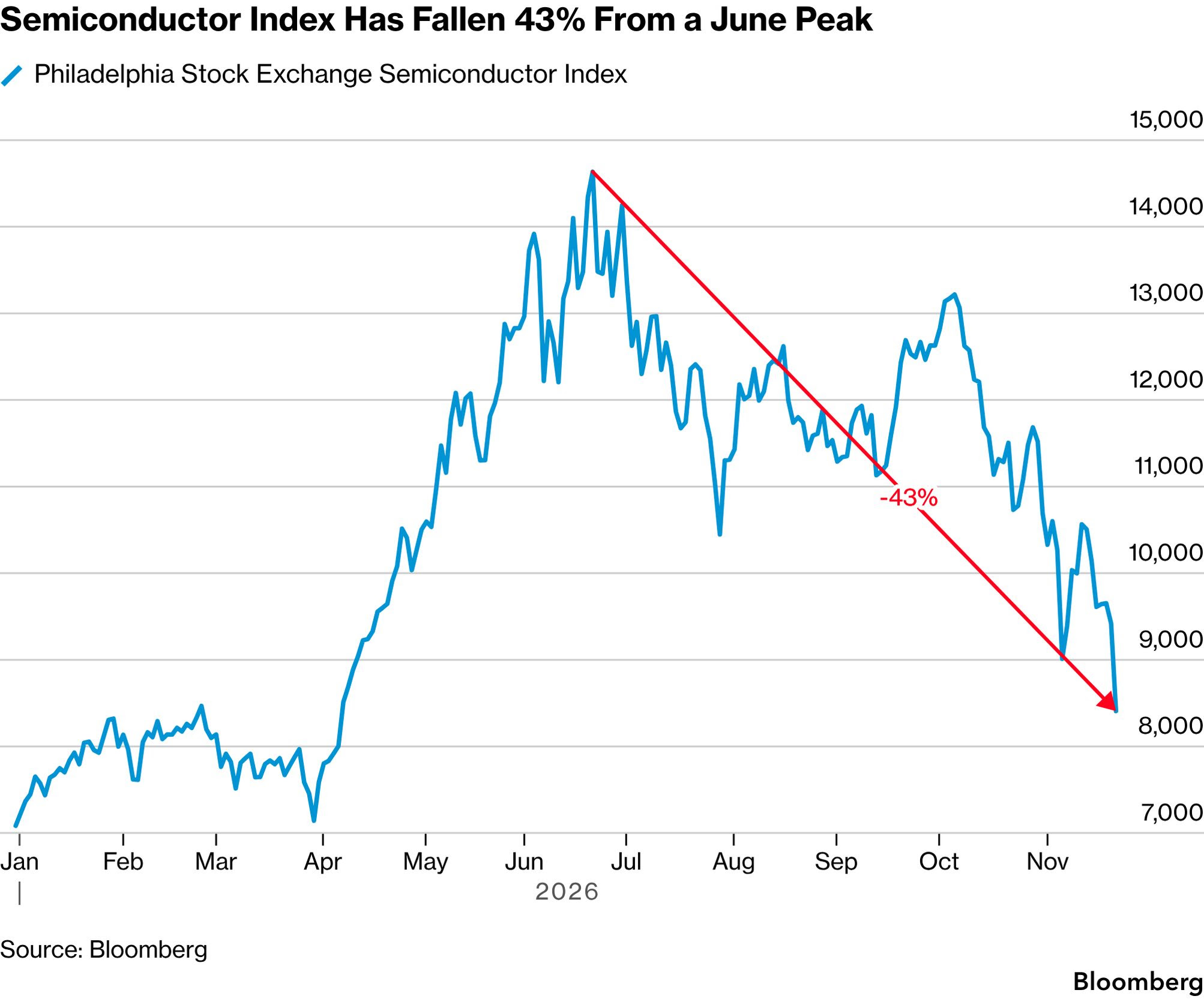 Philadelphia Semiconductor Index, January through November 20, 2026. Chart by Bloomberg.
Friday’s selloff left the Philadelphia Semiconductor Index 43% below its June peak, according to Bloomberg. Meanwhile, 95% of the 62 S&P 500 technology companies that had reported third-quarter results beat earnings estimates, according to Fundstrat and FactSet. The index follows chip stocks and the earnings tally covers a broader sector. Many technology companies cleared the bar for the quarter just ended. Nvidia’s forecast turns on which customers it can serve in the next one.
The companies that rent out computing power on Nvidia chips also rallied Monday. At 8:22 a.m. Eastern, Nvidia traded 8.9% above Friday’s close, Nebius 8.8%, IREN 8.1% and CoreWeave 7.2%. All three cloud operators had lost at least a quarter of their value the previous week. IREN had fallen roughly 36%, leaving it about 31% below its November 13 close even after Monday morning’s gain. For these companies, a customer who signs up to rent chips is only the first step. Revenue depends on getting those chips installed, powered and available to the customer.
In its fiscal third quarter, Nvidia shipped $2.4 billion of Hopper data-center products to China. That disclosure measures what Nvidia shipped to a named market. It cannot identify the ultimate user of a chip sold through a distributor elsewhere. The interview supplied no finding that the disclosed $2.4 billion of shipments violated export rules. Nvidia’s quarterly disclosure
The public accounts differ on a key date. Bessent said Nvidia removed Singapore-based Megaspeed from its sales list in August 2025. Commerce and Justice said their investigation began in 2024, Commerce asked Nvidia for records of direct and indirect sales in May 2025, and Nvidia put Megaspeed on its no-sell list in June. U.S. officials also worked with Singaporean authorities on an end-use check. Neither account establishes that Megaspeed diverted chips. The difference matters because a sales hold can stop the next order. It does little to trace machines already delivered. Commerce and Justice’s chronology
A House Foreign Affairs Committee disclosure shows the gap between permission and delivery. Across the Nvidia and AMD applications it described, the companies sought authorization for about 3.4 million AI chips, and licenses covering more than 879,000 chips were approved. A license allows a transaction to proceed. To establish how many chips actually moved and where they ended up, investigators still need sales, shipping and customer records. House licensing disclosure
There are two financial consequences for shareholders. The first is already visible in the forecast. Nvidia expects $130 billion of fourth-quarter revenue, give or take 3%, and assumes zero China data-center compute revenue in that figure. Subtracting the prior quarter’s $2.4 billion from the new forecast would count an exclusion management has already made. The outlook covers a fiscal quarter with an extra week.
The second consequence is harder to quantify. An overseas customer can own a server and rent access to its computing power to someone in another country. Bessent singled out remote access as a concern. Checking the shipping address helps with the original sale. Checking who can use the machine afterward asks more of the cloud operator and its suppliers. The board’s account of who could see those transactions will tell shareholders more about that exposure than another estimate of Chinese chip demand.
|
|
Amazon is in talks to buy an AI company that already uses its chips
Amazon is nearing a deal for Decart, which makes software that can edit video as it streams. Calcalist reported that cash, stock and deferred payments could put the price near $7.5 billion if Decart meets performance targets. That would be nearly twice the roughly $4 billion valuation investors gave it in May, when Nvidia joined a $300 million funding round. The companies have yet to announce a signed agreement. Deal reporting · May funding round
The commercial relationship already runs both ways. Decart uses Amazon’s Trainium chips, and developers can buy Decart’s video tools through AWS by the second of video they generate or edit. Buying Decart would give Amazon a share of the software revenue as well as a way to sell more computing time on its own chips. The test would be whether developers use enough paid video to justify that price. Decart on AWS Marketplace · AWS on Trainium
|
HPE promised shareholders 75 cents of every free cash flow dollar |  | Hewlett Packard Enterprise headquarters, archive. Wikimedia Commons. CC0. License
Hewlett Packard Enterprise reports fiscal fourth-quarter results after Monday’s close. Analysts expect $14.45 billion in revenue and $1.29 in adjusted diluted earnings per share. Both sit inside management’s September ranges. A separate promise gives shareholders a way to judge the quarter even if sales and earnings land right on target.
| HPE fiscal Q4 | Analyst estimate | Company guidance |
|---|
| Revenue | $14.45B | $13.9B–$14.8B | | Adjusted diluted EPS | $1.29 | $1.20–$1.30 |
Revenue estimate dated November 20 and EPS November 19. Data provided by Zacks Investment Research, Inc., www.zacksdata.com.
HPE put two numbers on the table in September. It expected at least $3.75 billion of free cash flow for the year and pledged at least 75% of fourth-quarter free cash flow to shareholders through dividends and repurchases. It had generated $2.581 billion through July. Reaching the annual floor therefore takes another $1.169 billion in the October quarter. If HPE meets both commitments, shareholders’ share comes to at least $877 million, rounded. That is our calculation from the two commitments.
The previous quarter shows how much has to change. HPE generated $958 million of free cash flow and returned $324 million, about 34 cents per dollar. Meeting the two September benchmarks would require roughly 22% more quarterly cash and more than twice the dollars returned. A large payout by itself answers only half the question. The cash flow statement will show whether the business generated the expected amount in the first place. HPE’s nine-month filing
Server sales and cash receipts can move on different schedules. Buying parts ties up money before a machine ships. Delivering it can create a receivable before the customer pays. A customer who pays a large invoice in November instead of October can therefore shift cash into the new fiscal year even though HPE recorded the sale on time.
HPE also reports operating profit for Cloud & AI, which includes servers and storage. Last quarter that segment earned a 17% operating margin, up from 7% a year earlier. The margin measures earnings on that division’s sales. The cash and payout figures cover all of HPE. Together they let shareholders judge two promises separately before Dell reports Tuesday. Can HPE sustain the improvement in equipment profits, and did it deliver cash to its owners?
|
|
Capricor’s FDA setback puts its $198.5 million reserve in focus |  | Building 64 on the FDA’s White Oak campus. The U.S. Food and Drug Administration / Wikimedia Commons. Public domain.
The FDA declined to approve Capricor’s resubmitted application for deramiocel, a proposed treatment for Duchenne muscular dystrophy. Capricor disclosed Friday that the agency found insufficient evidence of effectiveness and cited other clinical deficiencies. The company says two randomized trials met their primary endpoints. The trials cleared the measures the company had set. The FDA still has to judge whether the results, taken together, establish that the treatment works.
For shareholders, the immediate question is how much time and money it will take to answer the agency. Capricor ended September with $198.5 million in cash, cash equivalents, restricted cash and marketable securities. Management believes that balance can cover its planned operations for at least 12 months and said it is reviewing costs to extend the runway.
The latest filing shows why the answer matters now. Operations used $96.4 million of cash in the first nine months, up from $46.2 million in the same stretch a year earlier. That averages about $10.7 million a month, more than double the prior pace. Dividing the September balance by that average would make the runway look more predictable than it is. The balance includes restricted cash, and the cost of answering the FDA depends on what evidence the agency will accept. Capricor’s quarterly filing
Capricor has also been spending to make the treatment at scale. Before the letter, it had told investors it was adding cleanroom capacity in San Diego and aimed to validate that capacity in the first half of 2027. Keeping that work on track while addressing the FDA could preserve manufacturing time if the drug eventually wins approval. Slowing it could conserve money while management learns how long the clinical work will take.
An analysis of existing patient data and a new clinical trial would carry very different budgets. The company has yet to specify which steps will satisfy the FDA. Its estimate of how long the money will last applies to the plan it has today. On Monday, Capricor postponed its scheduled shareholder call while it prepares its response to the FDA. It gave no new date. Until management spells out the work ahead, investors know more about the cash available than how long it must last. Capricor’s Monday announcement
|
|
|


