TUESDAY, NOVEMBER 3, 2026  /  10-MINUTE READ

CASH & CHAOS

MARKETS, MONEY AND THE MADNESS IN BETWEEN.

Sponsored by

Good morning. Record sales are only half the earnings story. Apple faces a margin squeeze, Oracle is raising another $20 billion, and Palantir’s growth is producing real operating leverage. Nvidia’s cloud partners add a China wrinkle; Shopify and tonight’s AMD report round out today’s six investigations.

Apple’s record sales meet a holiday margin squeeze.

Apple Park photographed from the air in June 2024

Nils Huenerfuerst / Wikimedia Commons. Apple Park, 2024. · License

Fiscal Q4 results · released November 2

AAPL: $324.94 · −3.95% premarket. Snapshot checked 7:58 a.m. EST; versus Monday close.

Apple sold more and earned more, but kept less operating profit from each sales dollar. September-quarter revenue reached $114.5 billion, up 12%; operating income grew about 10% to $35.6 billion. Our calculation puts operating margin at 31.1%, down from 31.6% a year earlier.

The expense mix explains the gap. Research and development rose to $11.7 billion from $8.9 billion, accounting for roughly 87% of the increase in operating expenses. Apple has not identified every incremental research dollar as AI spending.

The headline gross margin also needs context. Reported margin of 47.9% included approximately one percentage point from tariff refunds. Excluding that rounded benefit gives about 46.9%, by C&C’s arithmetic. The refund also added five cents to reported EPS of $2.10.

The holiday outlook makes the pressure timely. Management expects December-quarter revenue growth of 7–10% and gross margin of 45–46%. On the call, the CFO identified memory costs as the main incremental margin headwind, with some additional Siri AI costs.

Services provides a valuable cushion: it generated about $24 billion of gross profit on $31.6 billion of sales. Cloud-based Siri expenses, however, also run through Services cost of sales.

Demand remains strong and research can create future value. For now, rising memory and computing costs are squeezing the benefit of record sales.

See Apple’s results and tariff-refund disclosure →

Oracle’s $20B financing adds shares and an interest bill.

Oracle campus in Austin photographed in 2018

DronePhotographer / Wikimedia. Austin campus, 2018 archive. · License

Offering priced November 2 · expected closing November 4

ORCL: $117.01 · −1.85% premarket. Snapshot checked 7:58 a.m. EST; versus Monday close.

Oracle’s AI buildout is drawing cash from customers, shareholders and lenders at the same time. Its latest financing prices approximately $10 billion of common stock and $10 billion of senior notes. The expected November 4 closing remains subject to customary conditions.

The equity portion comprises about 86.2 million shares at $116 each. Those new shares equal roughly 2.85% of the August share base. Existing holders will own a smaller percentage of the company; the effect on earnings per share also depends on the profit that the new capital produces.

The debt has a separate recurring cost. Across five tranches, coupons range from 7% to 8.65%. C&C calculates approximately $777 million of annual cash interest before taxes and issuance-cost amortization.

The latest quarterly cash statement shows why financing matters. For the three months ended August 31, Oracle reported $23.1 billion of operating cash flow and $28.5 billion of capital expenditure, leaving negative $5.4 billion of free cash flow.

Operating cash included $11.4 billion of customer prepayments carrying a significant financing component. These are real funds and evidence of customer commitment. They also come with future service obligations, so the cash-flow jump should not automatically be treated as a repeatable quarterly run rate.

Customer advances help finance capacity customers intend to use. C&C’s assessment hinges on whether that capacity produces durable cash after investment and interest.

Inspect Oracle’s share pricing and debt terms →

Palantir nearly doubles sales. Bookings need a closer look.

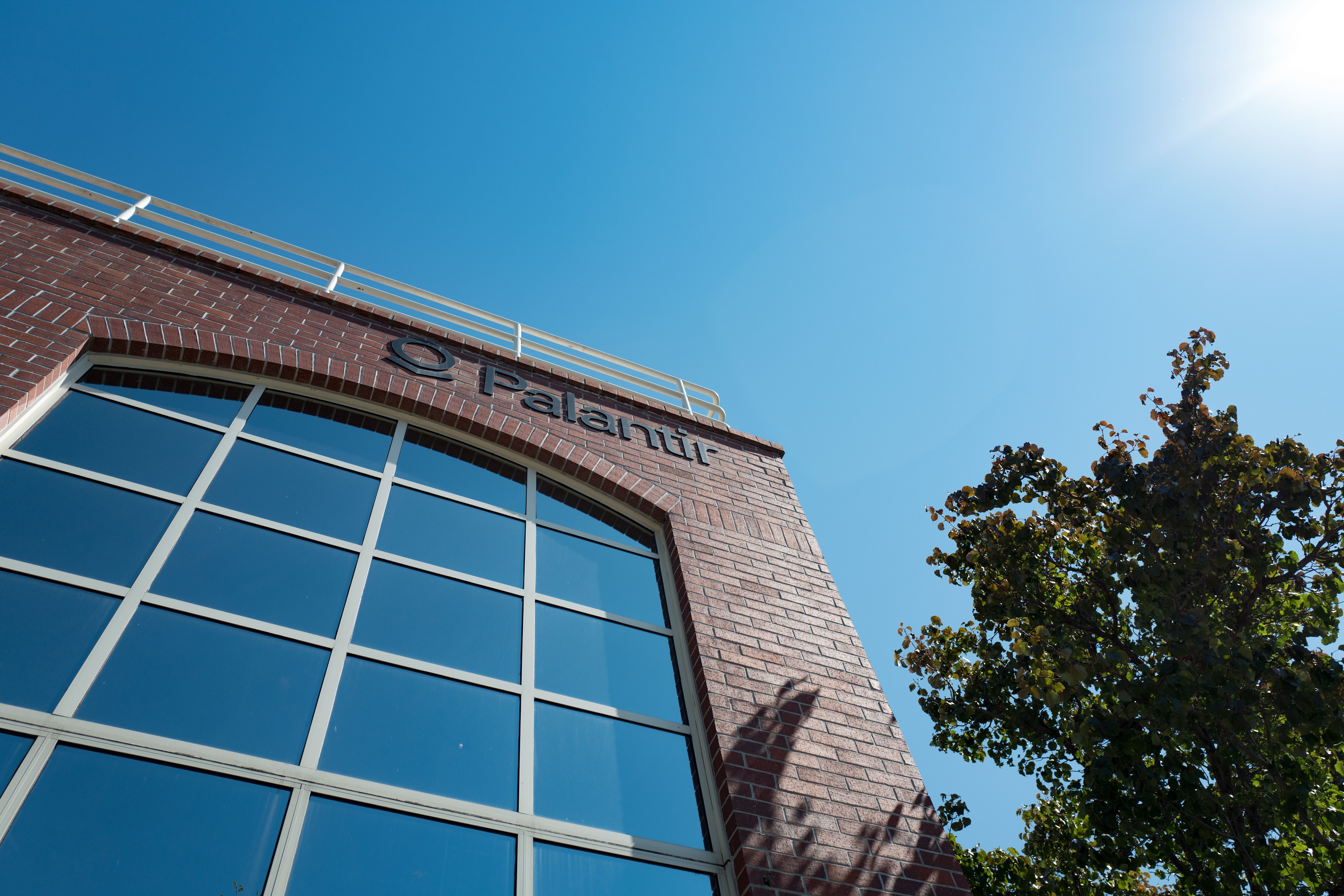
Palantir sign on its former Palo Alto office building

Smith Collection / Gado / Getty Images, via Axios. Former Palo Alto office, 2020 archive.

Q3 results · released November 2

PLTR: $166.75 · −6.50% premarket. Snapshot checked 7:58 a.m. EST; versus Monday close.

Palantir’s growth is producing substantial operating leverage. Third-quarter revenue rose 96% to $2.31 billion, while operating expenses grew about 46%. GAAP operating income reached $1.08 billion, equivalent to a roughly 47% margin.

U.S. commercial sales grew 148% to $984 million, slightly above the $953 million generated by U.S. government customers. Commercial demand provides a substantial second growth engine.

Existing customers are also expanding. Companywide net dollar retention reached 165%, a measure comparing revenue from a customer cohort over trailing twelve-month periods. U.S. commercial customer count rose to 686 from 530 a year earlier.

The adjusted profit figure is higher still: $1.43 billion, or about 62% of revenue. The accounting distinction matters. GAAP results include $319 million of stock-based compensation; the adjusted number removes that and other specified costs.

The less exuberant evidence sits in bookings. Total contract value grew 6% to $2.92 billion, while U.S. commercial contract value grew 11%. Management said shorter sovereign contracts explained part of the gap between bookings growth and recognized revenue growth. Contract length matters, but that explanation does not make future conversion automatic.

For Q4, Palantir guides to $2.649–$2.653 billion of revenue. C&C’s finding is favorable on execution. Sustaining this profitable expansion requires customer growth and contracts to keep converting into recognized revenue.

Compare Palantir’s retention, bookings and margins →

Nvidia’s China exposure extends beyond direct chip sales.

Nvidia headquarters with company logo in Santa Clara

Coolcaesar; edit by Jacek Halicki / Wikimedia. Headquarters archive. · License

November 3 reporting · latest filed quarter ended July 26

NVDA: $205.42 · +1.66% premarket. Snapshot checked 7:58 a.m. EST; versus Monday close.

Nvidia can exclude direct China compute sales from its forecast and still have indirect exposure through overseas clouds. The Financial Times reports that cloud clients received verbal instructions to sell at least 51% of their services to non-Chinese companies.

Nvidia did not confirm that specific threshold in its response reported by AFP. This is reported company guidance for cloud customers, rather than a newly enacted U.S. law or evidence of cancelled GPU orders. AFP reports the company response and scope.

The accounting explains the potential blind spot. Nvidia’s filing assigns geographic revenue by the headquarters of its direct customer, rather than the location of the ultimate user. A chip sold to an overseas cloud provider can therefore support Chinese end users without appearing as direct China revenue.

Its next-quarter revenue guide of $108 billion, plus or minus 2%, already assumes no data-center compute revenue from China.

There is also a cash mechanism. Nvidia disclosed approximately $36 billion of multi-year cloud service commitments under arrangements in which partners purchase its hardware and can redirect capacity to third parties. Customer diversification and utilization could affect how much of that capacity finds outside buyers.

The potential exposure spans hardware sales and cloud capacity commitments. The filing does not quantify a loss from this reported policy or identify all affected partners. Strong demand and supply constraints are meaningful counterevidence; diversification could reduce concentration risk without reducing overall orders.

Read Nvidia’s geography and cloud commitments →

Elon Musk. Jensen Huang. Washington. What’s the Connection?

AI is moving into the physical economy.  

Elon is building it. Jensen sees it in Agriculture. Washington is backing it. And DIT AgTech is already putting it to work in livestock. 

Most investors haven’t connected the dots yet. 

At $1 a share, you still can.

A CRM so smart, it updates itself.

HubSpot's CRM is so smart, it now updates itself. Calls get logged and summarized the moment they end. New leads get researched and a first outreach drafted, automatically. Deals move forward on their own, with next steps flagged before you have to ask. 

Even the one repetitive task you've been meaning to fix can now run itself, no code required. Customers using it are already seeing the difference. 

This isn't the CRM you have to work hard to figure out. It's the one already working before you log in.

The Mag 7 + three: Monday’s close.

StockCloseMonday
AAPL$338.32−1.83%
MSFT$507.12−2.83%
NVDA$202.06−1.26%
AMZN$245.63+2.20%
GOOGL$278.99−0.30%
META$606.73−1.34%
TSLA$403.82+1.00%
AMD$466.84−7.52%
AVGO$322.23−1.18%
MU$833.59−5.78%

USD. November 2 versus October 30 adjusted regular-session closes; excludes dividends. Editorial watchlist, not an official index. Apple and Palantir reported afterward.

Shopify’s profit scales faster than sales. Cash needs context.

Performance Court in Ottawa, a former Shopify headquarters building

Jeangagnon / Wikimedia. Former Shopify office at 150 Elgin, 2019; crop via Connect CRE. · License

Q3 results · released November 3

SHOP: $131.30 · −15.95% premarket. Snapshot checked 7:58 a.m. EST; versus Monday close.

Shopify is converting more revenue into operating profit even as gross margin falls. Third-quarter sales rose 32% to $3.74 billion, while operating income increased 66% to $568 million. Our calculations put operating margin at 15.2%, up from 12.1%.

The improvement came from expense discipline rather than stronger gross profit per sales dollar. Gross profit grew 28%, slower than revenue; gross margin slipped to 47.6% from 48.9%. Operating expenses grew only 16%, allowing more gross profit to reach the operating-income line.

Merchant solutions supplied $2.91 billion of revenue, compared with $836 million from subscriptions. The shift toward merchant revenue affects the mix, but subscription gross margin also declined. Neither the mix shift nor AI spending alone provides a complete explanation for the companywide margin change.

The cash result is strong, with qualifications. Shopify reported $816 million of free cash flow, a rounded 22% margin, versus $507 million a year earlier. Favorable working-capital movements supplied a $154 million swing, roughly half the increase in operating cash flow.

Beginning in April, merchant cash-advance flows moved from operating to investing activities. That placed $30 million of quarterly net cash use outside operating cash flow. Separately, net lending and advance flows consumed $229 million in investing cash, which the company’s free-cash-flow measure does not deduct.

Free cash flow therefore differs from cash remaining after every form of reinvestment, despite genuine operating improvement. For Q4, management expects low-thirties revenue growth and operating expenses at 29–30% of sales. Scale benefits are real; credit performance and lending cash demands also matter.

Inspect Shopify’s earnings and cash-flow statements →

AMD reports tonight. Revenue alone will not settle the AI case.

AMD headquarters in Santa Clara, photographed in 2020

Coolcaesar / Wikimedia. Santa Clara, 2020 archive. · License

Q3 preview · results after close; call at 5 p.m. EST November 3

AMD: $481.46 · +3.13% premarket. Snapshot checked 7:58 a.m. EST; versus Monday close.

AMD’s existing outlook implies substantial growth, but does not isolate the profitability of its new AI platforms. Its prior Q3 guide was $13 billion of revenue, plus or minus $300 million, at a 56% non-GAAP gross margin.

At the midpoint, that margin implies $7.28 billion of gross profit. Subtract guided operating expenses of $3.65 billion, then include guided other income, tax and diluted shares, and C&C’s illustration produces about $1.93 per share. This is our arithmetic using management’s assumptions, not company EPS guidance.

Holding the other inputs fixed, the revenue range produces approximately $1.84–$2.02 in that illustration. A revenue beat therefore helps, but product mix, margin and ramp costs can change the earnings outcome.

The latest reported quarter offers genuine operating evidence. Data-center revenue was $6.72 billion, up 107%, with a 31.3% segment operating margin. That segment combines CPUs and GPUs, so its profitability cannot be treated as a standalone AI-accelerator margin.

On the prior call, management said cloud and enterprise CPU revenue each grew more than 70%, while accelerator revenue more than doubled. EPYC broadens the growth engine, but undisclosed absolute accelerator sales limit product-level profit calculations.

The same call anticipated initial Helios shipments later in Q3, followed by a Q4 and 2027 ramp. Tonight’s December outlook and shipment timing will show more than a revenue headline alone. C&C’s focus: demand converting into recognized sales and attractive margins.

Review AMD’s prior guide before tonight’s report →

Election Day and the next labor-market checks.

Today’s September JOLTS report is scheduled for 10 a.m. EST. Openings, hires and quits distinguish employers’ hiring plans from actual job changes. Wednesday brings ISM services; Friday’s October employment report follows at 8:30 a.m. EST.

The midterm elections add a policy catalyst. Congressional control can influence taxes, spending and oversight; election results and their legislative consequences are separate steps.

Prediction markets: a heavy House favorite.

Polymarket’s Democratic House-control contract was priced at 94.5%, with a 94–95¢ Yes bid/ask, in its 7:54 a.m. EST source update. This is a venue price under its seat-count and caucus resolution rules, not a confirmed election result.

Analysts: Palantir’s target edges higher.

Piper Sandler raised Palantir’s target to $235 from $231 on November 3, maintaining Overweight. This is a target increase, not a rating upgrade; the brokerage opinion is separate from the operating results above.

Crypto, briefly.

Bitcoin traded at $77,277.40 and Ether at $2,279.23 in USD spot trades timestamped about 7:59 a.m. EST Tuesday. These are snapshots, separate from the stock closing-price table. Bitcoin · Ether.

Forwarded this email? Get Cash & Chaos in your inbox.