The case for buying the chip index over individual stocksAmbarella reported $115.2 million in revenue for its October quarter. The camera-chip designer expects just $70 million to $75 million next quarter, a 37% drop at the midpoint. CEO Fermi Wang said scarce, expensive memory had forced customers to scale back their plans. The same high memory prices that lifted Micron’s profits made it harder for Ambarella to sell processors.
All 30 stocks in the Philadelphia Semiconductor Index rose on Monday. All 30 fell on Tuesday. By Wednesday afternoon Nvidia was still up almost 18% from Friday’s close. Micron had given back nearly its entire gain. The two companies can sell parts for the very same server and leave their shareholders with quite different returns.
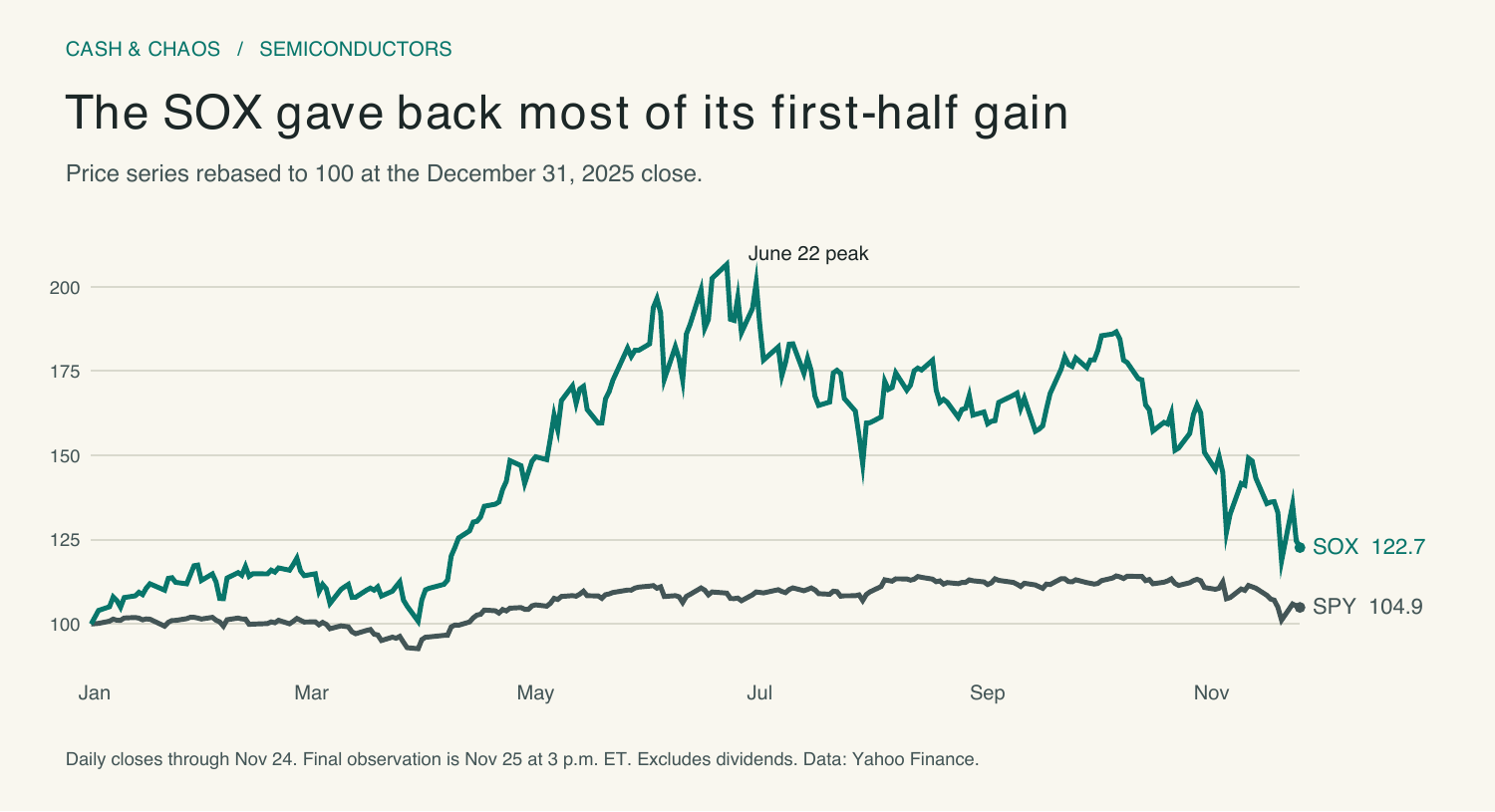
At 3 p.m. Eastern on Wednesday the index stood at 8,689, down 40.6% from its June closing high. Someone who owned it from the end of December was still ahead 22.7% before dividends, against a 4.9% share-price gain for SPY, the fund that tracks the S&P 500. Chip stocks had more than doubled in under six months before the selloff began.
A cloud company that commissions its own processor can take an order away from Nvidia, give design work to Broadcom and still have TSMC make the chip. Memory suppliers have a different stake. Micron earns more when memory stays scarce. The companies assembling servers have to pay those prices. A shareholder in the index owns some of each business.
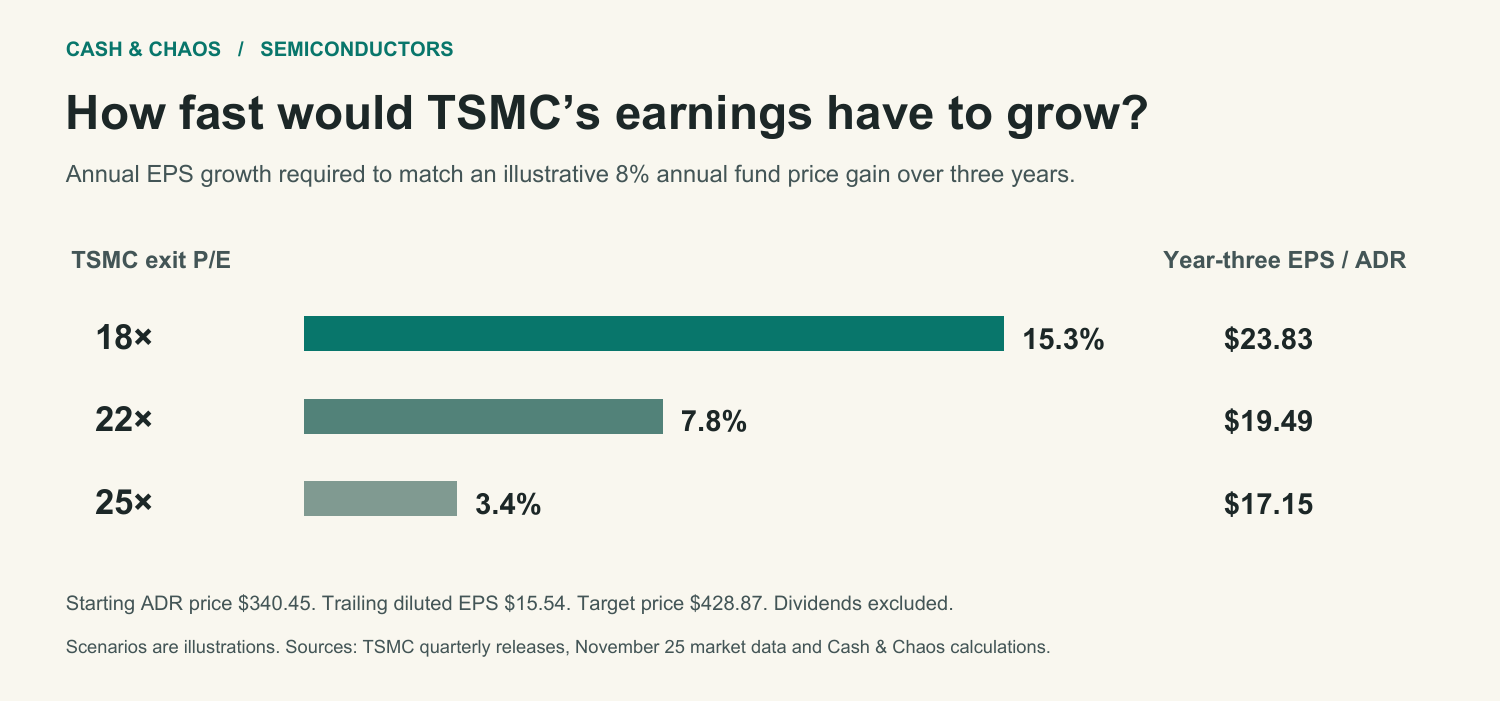
For someone who expects chip demand to grow, Invesco’s SOXQ is the more appealing starting point. Owning Nvidia alone means betting on how much profit it keeps from the next server. Owning Micron means betting on the price of memory. The index owns both, along with the designers, factories and equipment makers that share in the spending. TSMC at $340.45 per American depositary receipt (ADR) offers a way to test how much a single company must earn to make concentrating that bet worthwhile.
|
|
How many chip stocks beat the fund?Nasdaq’s semiconductor index, usually called the SOX, includes 30 large U.S.-listed companies. They design and manufacture chips and supply the tools and materials that go into them. The U.S. listing requirement admits Taiwan’s TSMC and the Netherlands’ ASML. An investor can buy an American-listed sector fund and acquire considerable exposure to events in Hsinchu and The Hague.
At a rebalance, Nasdaq caps the three largest positions at 12%, 10% and 8%, respectively. Each remaining position is capped at 4%. Those weights can drift as the stocks trade. A 10% gain in a company with a 12% starting weight adds about 1.2 percentage points to the index. The same gain in a 2% position adds about 0.2.
After Nvidia reinstated Jensen Huang, the SOX rose 14.0% on Monday. The median constituent gained 14.5%. On Tuesday the index fell 7.9% and the median stock lost 8.6%. By 3 p.m. Wednesday, eight names had risen from Tuesday’s close and 22 had fallen. Twenty-six still traded above Friday’s close. The round trip left the median stock 2.7% above Friday.
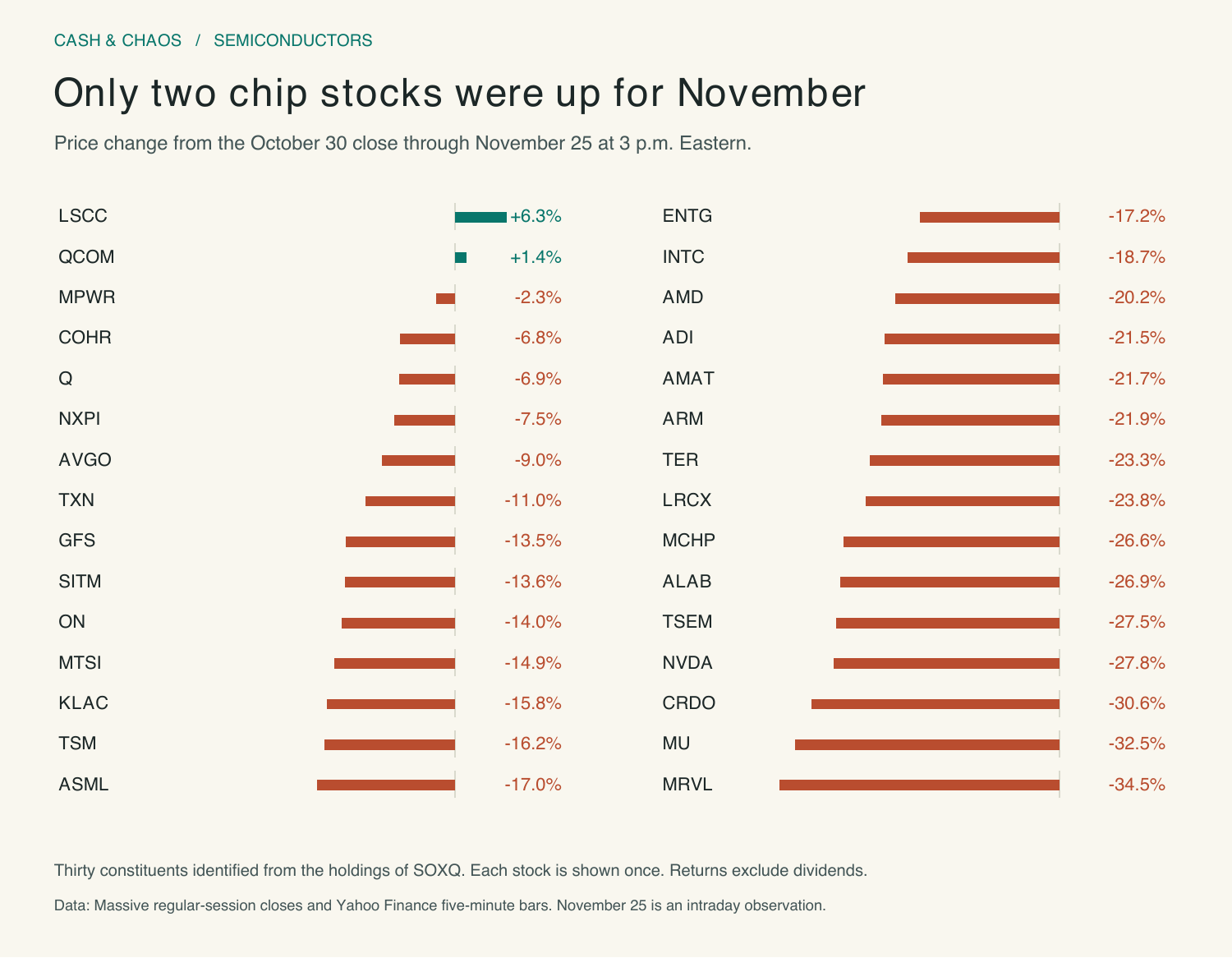
Only Qualcomm and Lattice Semiconductor were above their October 30 closes. Yet 16 of the 30 stocks beat SOXQ, including 14 that lost money. A $10,000 purchase of TSMC on October 30 was worth about $8,383 by Wednesday afternoon. The same investment in SOXQ was worth $8,136. Micron left its buyer with $6,749. Each figure excludes dividends.
The funds differed, too. Over the same three trading sessions, SMH gained two percentage points more than SOXX. An investor who already owns Nvidia directly can end up with quite different exposure depending on which fund sits alongside it.
| Fund | Benchmark | November to date | Since Friday’s close |
|---|
| SOXQ | PHLX Semiconductor Sector Index | −18.6% | +3.3% | | SOXX | NYSE Semiconductor Index | −19.5% | +2.6% | | SMH | MVIS US Listed Semiconductor 25 Index | −19.9% | +4.6% | | SPY | S&P 500 | −5.3% | +3.7% |
|  | |
|
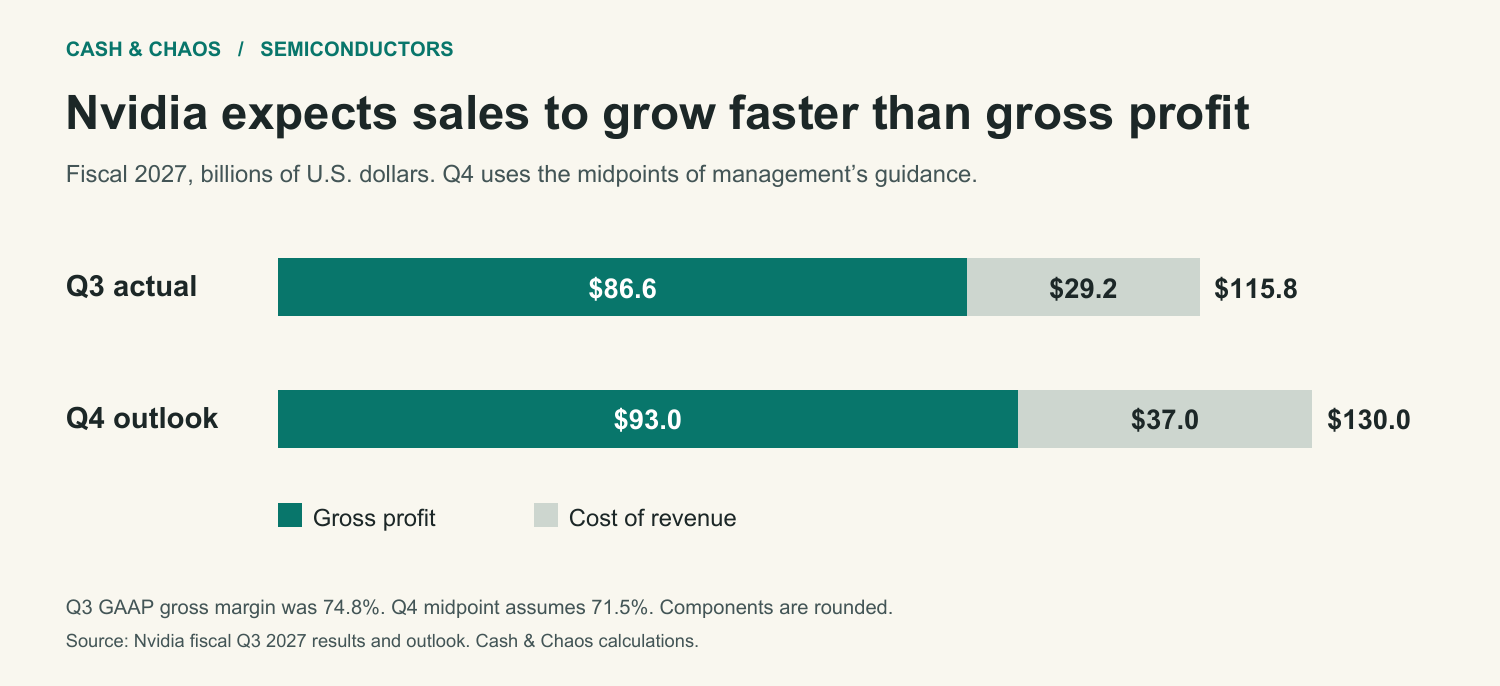
Nvidia can sell more and keep less of the next dollarNvidia reported $115.8 billion in fiscal third-quarter revenue, including $107.6 billion from data centers. Its fourth-quarter forecast calls for $130 billion in sales, give or take 3%. The midpoint adds about $14 billion in one quarter and assumes zero China data-center compute revenue.
Nvidia earned a 74.8% GAAP gross margin last quarter and expects 71% to 72% in the next. At the midpoints, gross profit rises from about $86.6 billion to $93.0 billion. Sales grow roughly 12%, but gross profit grows only about 7%. Hold the old margin constant on $130 billion and Nvidia would earn about $4.3 billion more in gross profit than the new forecast implies.
If early production runs prove particularly expensive, higher volumes could help Nvidia earn some of that margin back. If scarce parts stay expensive or large customers negotiate lasting discounts, the lower margin could persist. At that level of sales, recovering one point of margin would add $1.3 billion in quarterly gross profit.
|  | Dell reported $22.03 billion of AI-server sales in its October quarter and raised its annual target to $78 billion. It needs another $23.44 billion in the final quarter to get there, about 6.4% more than it just delivered. Nvidia can sell a processor that Dell installs in a server. Both companies record a sale. Adding their figures together would count the processor twice as evidence of what the ultimate customer spent.
President Trump also raised the possibility of a U.S. government stake in Nvidia. On Thursday, Unusual Whales reported that Kalshi traders put the chance of a stake by year-end at 35%, up from 14% a day earlier. Shareholders would still need to know whether the government would buy existing shares or ask Nvidia to issue new ones. Only the latter would dilute their ownership.
|
|
Who pays for the next rack?A cloud operator buys a rack of servers, equips a building to run it and sells the computing time to customers. The chipmaker can earn its margin months before the operator learns how many hours a day the rack will earn rent. Electricity, financing and maintenance continue during the idle hours. The first customer helps pay for installation. The customer who renews after faster chips arrive determines how long that machine earns its keep.
CoreWeave’s third-quarter revenue climbed to $3.66 billion from $1.37 billion a year earlier. It earned $207 million from operations and recorded $846 million of net interest expense. Net interest ran more than four times operating income. Depreciation reduces operating income without using cash that quarter. The gap between profit and interest expense therefore says little on its own about CoreWeave’s ability to pay its next bill. Management expects another $1.05 billion to $1.15 billion of interest expense in the fourth quarter. A delay bringing a site online pushes out the first rental payment even as interest accrues on money already borrowed.
Management expects $37 billion to $39 billion of capital spending in 2026 against $13.0 billion to $13.3 billion of revenue. At the midpoints that is almost $2.90 of investment for each dollar of current-year sales. The company is building capacity intended to produce revenue over many years. CoreWeave’s definition makes future revenue contingent on delivering capacity and keeping service available.
Amazon can fund construction from several businesses. AWS sales grew 39.3% year over year in the third quarter, reaching a $184 billion annualized run rate. Amazon also reported $42.4 billion of negative free cash flow over the preceding twelve months, driven principally by a $94.8 billion year-over-year increase in net purchases of property and equipment. That outflow covers the entire company, including its retail operations. AWS can be profitable while Amazon shareholders finance buildings and equipment whose customers will pay over several years.
On Thursday, the Financial Times reported that Dell and Supermicro had told buyers in Malaysia, Singapore, Thailand and Indonesia that Nvidia had put their server shipments on hold. The duration of the pause was unclear. Bloomberg separately reported that at least one fund had declined to join a $300 million loan for chips at a Thai data center intended to serve Tencent. A cloud operator that has already borrowed to equip a site can owe interest while it waits for the servers it needs to start billing customers.
|
|
Memory, custom silicon and two different kinds of competitionAt $597.10 on Wednesday afternoon, Micron traded at about eight times its $74.33 of fiscal 2026 GAAP earnings per share. In fiscal 2025 Micron earned $7.59 a share. At Wednesday’s price that comes to nearly 79 times earnings.
In fiscal 2023 Micron lost nine cents at the gross-profit line for every dollar of memory it sold. In fiscal 2026 it kept 81 cents before operating expenses. Micron shipped roughly a quarter more bits of both DRAM, used for working memory, and NAND, used for storage, than in 2025. Average selling prices rose about 180% for DRAM and about 200% for NAND. Customers bought more memory, but the price they paid for each bit did most of the work.
| 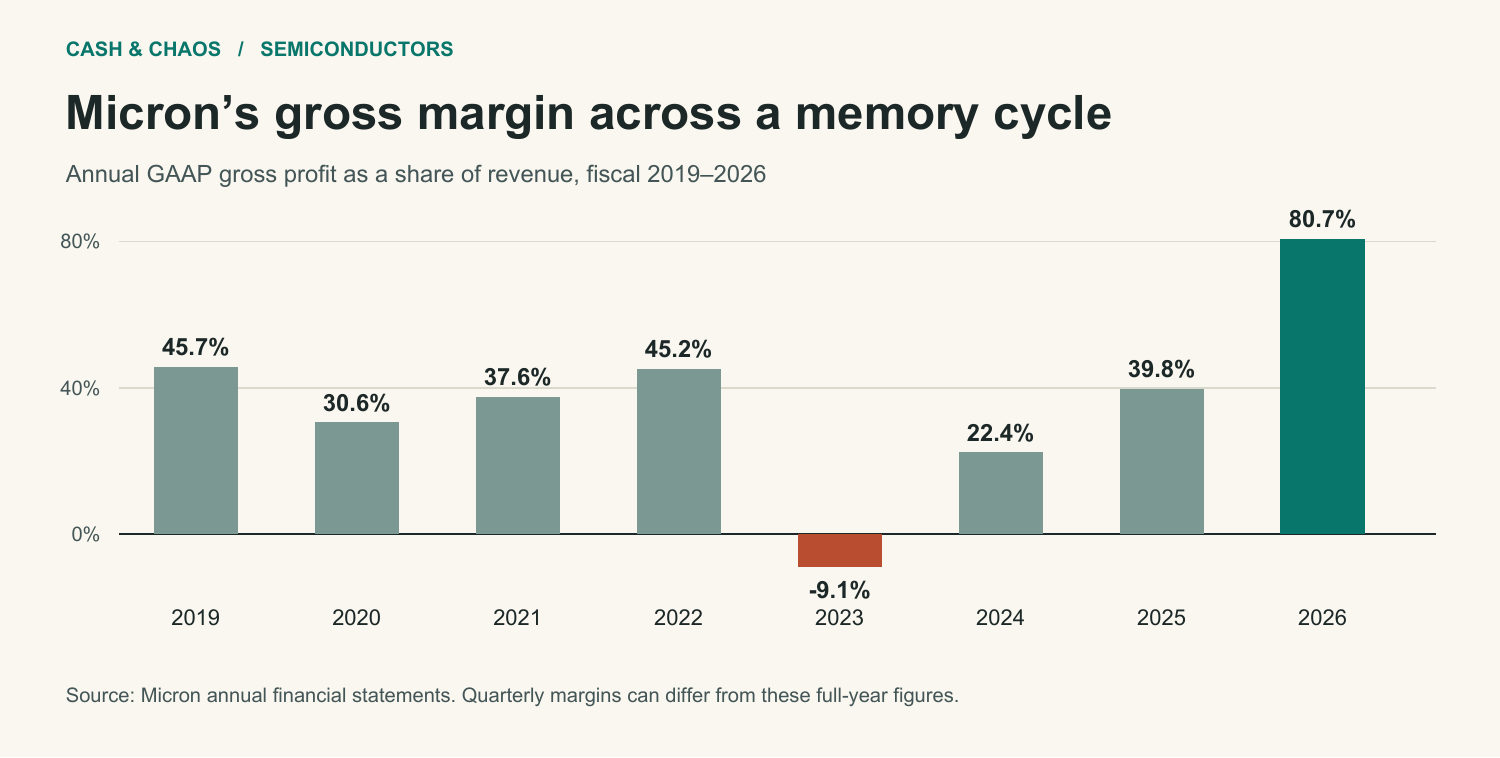 | By the final quarter, gross margin had reached 86.8%. At that quarter’s $54.2 billion of sales, a five-percentage-point margin decline would cost about $2.7 billion of gross profit even if revenue held steady. If memory prices fell enough to bring revenue down too, the hit would be larger.
Micron disclosed about $134 billion of revenue still to be earned under customer contracts at fiscal year-end. A year earlier the balance was immaterial. Some customers now commit to multiyear volumes on take-or-pay terms, and most strategic agreements put a floor and a ceiling on prices. Micron expected to recognize about a quarter of the $134 billion within twelve months, roughly $33.5 billion. Micron recorded roughly $13 billion in contract liabilities, mainly deposits, nearly all scheduled for repayment between 2029 and 2031.
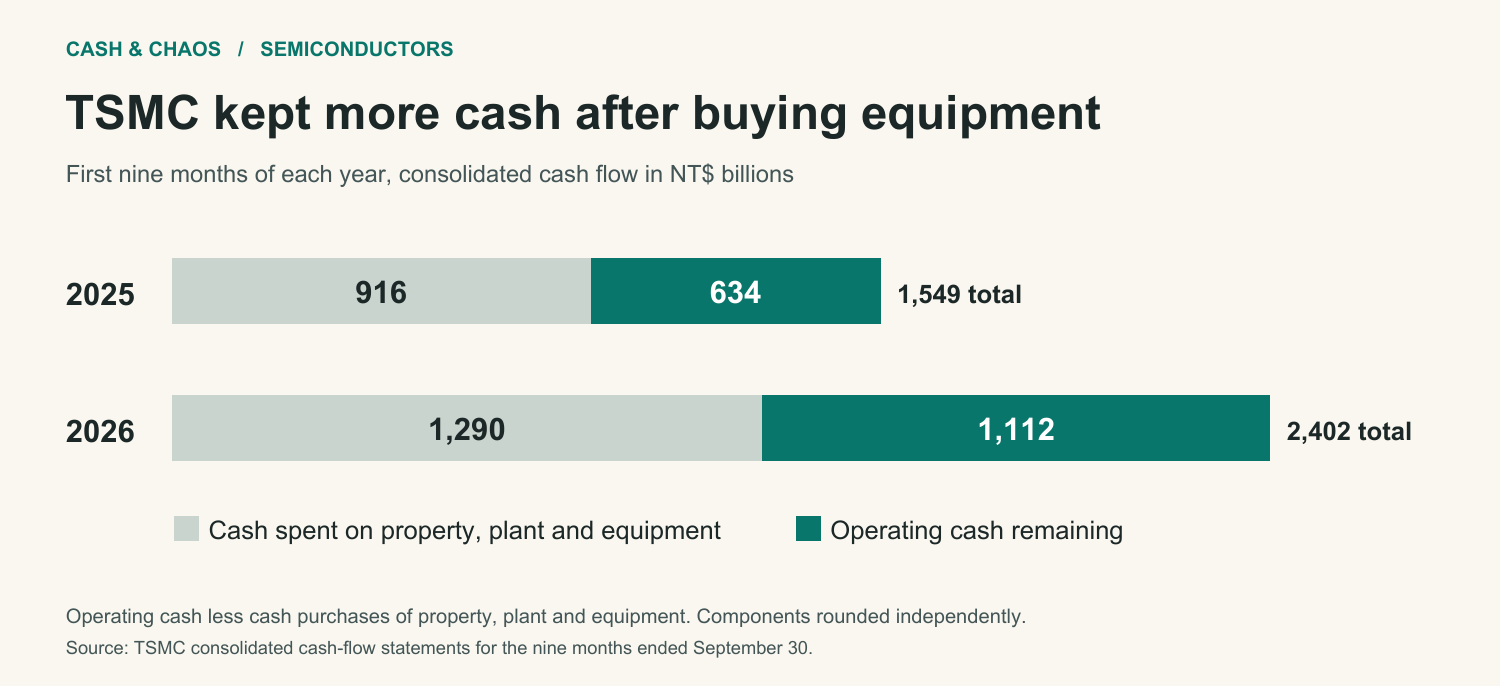
Those commitments give Micron more protection than it had in 2023. A buyer can take every bit it promised and still pay much less than today’s price. At the contract’s minimum price, Micron’s profit depends on what it costs to make the memory when the order comes due. Micron spent $10.77 billion on net capital investment in the fourth quarter alone.
Broadcom sold $16.7 billion of AI semiconductors in its fiscal third quarter and forecast $21.7 billion for the fourth. That $5 billion increase, roughly 30% sequentially, includes custom accelerators and networking. A cloud company commissioning its own chip can take some work away from a general-purpose graphics processor while creating business for Broadcom. It may also need faster connections between machines regardless of whose processor goes inside them. Buying Nvidia and Broadcom together gives an investor competing claims on some budgets and overlapping exposure to others.
AMD’s data-center business nearly doubled year over year to $8.55 billion in the third quarter. That segment includes EPYC server CPUs as well as the newly launched MI450 graphics processors. Crediting every dollar to GPUs would manufacture a market-share gain the accounts do not establish. AMD’s companywide fourth-quarter revenue midpoint is $17 billion, up roughly 27% sequentially. The more persuasive evidence for a shareholder would be customers reordering systems in volume and segment profit growing alongside those orders.
|
|
|